Saturday, 30 August 2014

Throw another Quorn on the barbie

This post is about Quorn. Not the town in the Flinders Ranges, but the food. Never heard of it, you say.

Barbecued Quorn

The story of Quorn starts in the 1960s. This was the time of books like Paul Ehrlich's The Population Bomb. People were looking at the future and worrying. One of the concerns was that there would be a food shortage, and more specifically a shortage of protein, within a couple of decades.

One food company decided that it would be a good idea to research mycoprotein for human consumption. The idea was that rather than the inefficient process of raising animals for food, you instead took some cheap feedstock (in this case, starch-based waste products from cereal manufacture) and fed it into a fermentation vessel where it was used to grow a single-celled organism, such as a yeast or a fungus. With an appropriately chosen organism, you could produce a nutritious, protein-rich food on an industrial scale. Just what was needed to feed the starving, overpopulated world that many had predicted.

Had things worked out differently, they might have virtually saved the world, and become immensely rich in the process. As it happened, they ended up producing a niche product, unknown to the majority.

Quorn has a bit of an image problem. It's essentially a mould that has been processed in a factory to resemble meat, so it immediately evokes the response "Ewwwwww!". Which is illogical; we eat mushrooms which are a fungus. We eat bread and cheese and drink beer and wine, all of which are synthetic foods produced by fermentation. We even eat processed meat products like sausages, whose production would make the average person physically ill to witness. Much of the stuff we eat already comes from nameless factories. For instance, the "cherries" in a fruit bun are most often made from Calcium Alginate (extracted from seaweed) with artificial colouring and flavouring.

Because Quorn is something that's manufactured, it doesn't have any intrinsic flavour any more than - say - a car has an intrinsic colour; it's a case of "tell us what flavour you want". This is a problem. If you tried to create a strong distinctive flavour for it, most people would reject it as being unfamiliar, and it would rule out many traditional dishes which are expected to have specific flavours. If you try to emulate an existing flavour - say lamb or beef - you'll never do as well as the original article. You can try to make the flavour as neutral as possible, but then people will taste it and say "Meh" and "Why bother?".

The creators of Quorn have tried a mixture of the second and third approaches, with a surprising amount of success.

Nevertheless, Quorn seems to have few supporters in Australia.

The "average" Aussie, used to steaks and roasts, would reject Quorn as some weird hippie nonsense (although they would most likely not phrase it this politely). Why eat some meat substitute when you can eat Real Meat? they would say.

Whereas the hippies in turn would look in askance at this strange and possibly sinister synthetic food - one step short of Soylent Green - and stick to their organic tofu and lentils.

Foodies, although more willing to try the unusual, would probably not be so interested in an inauthentic ingredient which has (intentionally) an unexciting taste.

Fast food outlets could probably use the stuff very efficiently, but it seems they have to appeal to the masses and make a big deal of using "100% beef"*.

[* = I would never make the libellous suggestion that this means they use 100% of the cow; tail, hooves, eyeballs and all.]

The "Housewife" (and I'm afraid that this is still a valid title in this backward country) has probably never heard of it, and would be doubtful about introducing such an alien product to her family.

So Quorn falls, unloved, between the various camps.

Which is a pity, because the rationale behind this food still holds; it's a high-protein food similar to meat, but can be produced without the inefficiency (and often cruelty) involved with farming animals. Also, unlike factory farming practices (and even sustainable/organic farming for that matter), the process is under tight control, so you virtually eliminate the possibility of disease.

I eat Quorn myself.

I understand the virtues of growing your own food or buying it fresh from a local market, but here in the Brisbane suburbs it's a case of the local Coles/Woolies or fighting your way into the city to get to a market that's barely any better. So if you're going to buy stuff from an amoral faceless corporation like Coles Group, you might as well go the whole hog and get a completely artificial food.

The price of Quorn is comparable with free-range chicken. The economies of scale are such that Quorn could be very much cheaper than this if it were more widely eaten, but since it's a niche product, you have to pay a premium price.

Quorn comes in a number of different forms, the majority of which are aimed at the convenience food market (the holy trinity of the corner store - Pies, Pasties and Sausage Rolls - are there). This is not the emphasis that I personally like, but it's understandable under the circumstances.

My favourite variety, for reasons of taste and versatility, is Quorn Pieces.

Quorn Pieces

These are meant to substitute for chicken pieces and are intended to be used in a sir-fry. In terms of taste, texture and appearance they are almost indistinguishable from chicken, however I find them to be overall superior because they are easier to prepare and they absorb flavours much better. This is where Quorn beats tofu hands-down. Tofu has a texture like synthetic rubber and actively repels flavourings. It takes a first-class chef to make tofu taste any good, whereas anyone who can put together a meal can get good results with Quorn.

Quorn pieces cooking in a very well seasoned wok

When stir-frying, Quorn pieces can be cooked in pretty much the same way as chicken. Cook them from frozen (there's no real advantage in thawing them first, although you can do this if you want to), and use a little more oil than you would normally use for meat, since they are almost devoid of fat. Cooking time is about the same.

The standard (I believe) method of cooking a stir fry (cook the meat first, set it aside to rest while cooking the vegetables, and then add it back in at the end) works well with Quorn. I usually drizzle the Quorn with kecap manis (sweet soy sauce) and sprinkle with spices while it's resting - Quorn absorbs the flavours and they seem to come through better than when the spices are added separately to the wok.

A Quorn stir-fry

A quick and easy meal is to stir-fry some Quorn pieces and wrap in pita bread, along with lettuce and tomato and whatever sauce you favour (a home-made Caesar dressing works well, as does sweet chili sauce and sour cream). This is essentially a donner kebab. It's very tasty and can be done at a moment's notice.

You can also thread Quorn pieces onto a skewer and cook under a grill or on a barbecue. The trick is to select the biggest pieces from the packet and stir-fry them first for 3 to 4 minutes to firm them up. You can then marinade them and thread onto the skewer. Simply thawed, they are too brittle and can break when skewered, but a little cooking first makes it much easier.

Tandoori Quorn with steamed vegetables

The Tandoori Quorn above and the barbecued Quorn at the start of this entry were both made this way. The barbecued Quorn was simply marinated in store-bought barbecue sauce.

There are a couple of other varieties of quorn which can be used as basic ingredients (as opposed to those varieties which are essentially prepared meals):

Quorn Mince


This is meant to substitute for minced beef. You could use it in a dish like spaghetti bolognaise and most likely no one would be able to tell the difference. I've also successfully used it in spring rolls.

Quorn Fillets


These look like fish fillets, but are meant to substitute for chicken breast, although they seem a little denser in texture. They are not quite a 1:1 substitute for chicken (e.g. if you simply fry one up and present it with minimal seasonings, as shown on the packet, you'll be able to tell that it's not chicken), but I can attest they work really well in a parmigiana. Don't try to flatten them with a mallet (they're already flat enough and tend to disintegrate when hit), but thaw, coat in beaten egg and bread crumbs and proceed as with a normal parmigiana.

To sum up:

Quorn isn't a wonder-food that's going to cure all of your ills and turn base metals into gold, nor is it some incredible taste sensation that will have the gourmets writhing in ecstasy. It is, however, an extremely under-appreciated and versatile ingredient, which is convenient to use and very easy to get good results with.

If you want to cut down on your (or your family's) meat intake for health or other reasons, it gives you an easy option because it can be directly substituted for meat in many dishes.

Saturday, 23 August 2014

Who will rid us of this troublesome Abbott?


Peta Credlin and her amazing evil monkey puppet
source

This post is a little unconventional as far as blog posts go because I'm not trying to reveal my deep inside knowledge and incredible insights to an adoring audience of millions (that was sarcasm, by the way), but instead I'm posing a question, because I'm having difficulties in coming to grips with exactly how best to approach the horrifying situation this country finds itself in.

With my previous post on this subject (of only five months ago, but it seems like longer) I thought it was worthwhile to list the actions and policies of the Abbott government with which I disagreed. It was a long list and I ended up having to generalise, but I thought it was worth doing; partly to raise awareness amongst those who hadn't been paying attention, and partly to dispute the assumption that "all politicians are as bad as each other and there's nothing you can do about it". [OK, I don't have any audience worth speaking of, so this was arguably a waste of time. Nevertheless, you never know who'll get here via an obscure search, or what might suddenly go viral and if we all do our bit to fight the bad memes etc. etc. ]

But now it seems things have got worse to the extent that there doesn't seem to be any benefit in listing policies or explaining why they are wrong. All but the wilfully blind can see what is happening, and all but the wilfully ignorant (or those who hope to benefit from what is essentially systematic wrecking of the country) can see that it's bad.

A couple of examples from personal experience:

A few months after the election I was working in a Northern Territory town. I won't be naming any names. This town is a red-necked place where, until recently, Aboriginal people were openly referred to by many as "coons" (now they use the word "indigenous" with an ironic wink, which is not much of an improvement) and where Rudd's Apology was greeted with foaming-at-the-mouth rage.

Two workers were trading banter and one retorted "Next you'll be saying I voted for Tony Abbott!". This, apparently, was the worst possible insult that he could imagine.

At another work-site in the North of Queensland (not quite as red-necked but hardly a hot bed of left-wing radicals), a feeling of resentment against the government seemed to hang over the place like a toxic cloud. In the past, during the worst parts of the media campaign against Gillard, you'd hear a few people sounding off here and there, but it was nothing like that this time. This time a feeling of depression and suppressed anger seemed to fill every single person in the place.

There was a worker there who rides a Harley. He is dead-set against the current fire-arms laws and desires a return to the Gold Standard (which is the identifying mark of a libertarian). I wouldn't be surprised if he had a Confederate flag flying outside of the caravan in which he lives. [I should in fairness point out that he's a really good person to work with: easy to get along with, highly skilled and willing to go to considerable personal inconvenience to do a job right. Stereotypes only go so far.]

Politically speaking, you would think he would be a natural Abbott supporter, but he is irate at the Abbott government. His opinion is that their handling of the country is so bad that they should be executed for treason. He had never said anything like this about Rudd or Gillard.

And that was before the budget came out...

So there doesn't seem to be any point in banging on about how loathsome Abbott and his partners in crime are, and why what they are doing is so disastrous. It's like an outbreak of the Black Plague; everyone gets that it's bad, and most important thing is working out what can we do about it.

So what can we do about it?

It seems to me that there is only one reason that Abbott is currently in power: the vicious, unrelenting and totally one-sided press campaign against Labor. In my entire life (and bear in mind that I've lived through the greater part of the Cold War) I have never seen such blatant bias and outright lying by such an overwhelming majority of the mainstream media.

If it was wasn't for that, there's no way Abbott could have won. He has an obnoxious personality, his political views are extremist and out of step with perhaps 90% of the population, and his party didn't go to the election with any real policies (three-word slogans don't count). In any remotely fair contest, the Coalition would have been decimated.

The fact that the media is specifically biased in favour of the Coalition (rather than, say, just being right-wing in general), is most clearly indicated by the behaviour of the Coalition itself. They seem confident to tell obvious lies and contradict themselves in the most blatant manner. The only way that they would this is if they know the media will always cover for them.

And when I say "media", I am of course talking about Rupert Murdoch.

Now, the book Coup d'Etat - A Practical Handbook [Edward Luttwak 1968] - which is a sort of 20th Century version of Machiavelli's The Prince - has the following to say:

"If a political entity is actually controlled by a group which is not structured politically, then obviously political methods cannot be used to seize power. This is the case of a country dominated by a business unit. Imagine, for example, that General Motors did control the USA, in the sense that the Presidency and Congress acted as its stooges. If that were the case, power would have to be seized in Detroit, not Washington."
So it would seem that rather than worrying about Abbott, a better strategy would be to concentrate on Murdoch. It makes more sense to destroy Sauron than waste your effort fighting his orcs and trolls.

But how can this be done?

As Luttwak has pointed out, the normal political tools - protests, petitions and so on - aren't of any use.

Boycott his papers? Maybe, but they make a loss anyway. Their purpose is to influence people and not to make money.

I'll be damned if I want to wait around for him to die off; he could hang around for another decade or more, and cause an extraordinary amount of damage in the process.

Any suggestions? Anyone?

Help, please!

Monday, 28 July 2014

World's Best Practice

In the light of recent events - namely airliners dropping out of the sky like flies in an insecticide commercial - my previous post might look a bit precious; whinging about minor annoyances on an airline that has an unrivalled reputation for safety. First World Problems indeed.

In fact, I believe my complaints are all the more relevant, because they show that Qantas is continuing to embrace a "Worlds Best Practice" philosophy.

"Worlds Best Practice" seems like a good thing. How can it mean anything other than that you are the best in the world?

In reality it's a deceptive piece of corporate jargon. You need to ask "best for whom?".

For instance; some other airlines might be able to get away with half the ground crew of Qantas. Clearly (at least to the short-sighted bean-counters in charge) it would be better for the company to match this level of "efficiency". Half of the ground crew staff are then sacked. This is what "Worlds Best Practice" means.

It reminds me a bit of the rhyme: "Good, better, best / Never let it rest / 'till your good is better / and your better best." It can be twisted to mean the opposite of what it was intended to say. Consider this:

When something is good, it is good in comparison to some relatively objective standard. You can always argue about exactly what constitutes a "good" apple, but a blackened and bruised apple with worms in it would not be described as "good" by any honest person.

When something is better, it is only more good in comparison to something else. Thus the blackened and bruised apple above may be described as "better" when compared to an apple that has deliquesced into a pool of rottenness, teeming with maggots.

When something is best, it the most good out of a group. Unfortunately, that group may have no other members in it. The deliquescent apple above might be the "best" apple in the kitchen of a particularly piggish bachelor, if it's the only apple they have.

That is to say, "best" can be worse than "better" which can in turn be worse than "good"; it all depends on what you are comparing things to.

"Worlds Best Practice" means using the rest of the world as a reference point to aim at. We are now seeing what airlines are like in the rest of the world.

Do we want this here?

Saturday, 12 July 2014

QANTAS Baggage Handlers' Football Club: Favourites for the World Cup

It is arguably unfair to put the boot into airline baggage handlers, since they are only a symptom of deeper problems with our national airline. Nevertheless, it's a bit like the mugger who comes from a broken home; the ultimate cause behind their behaviour might lie elsewhere and they might be worthy of some sympathy - but that sympathy reaches its limits when it's your kidney they're poking a knife into. Or in this case trying to drop-kick your luggage into the back row of the grandstand.

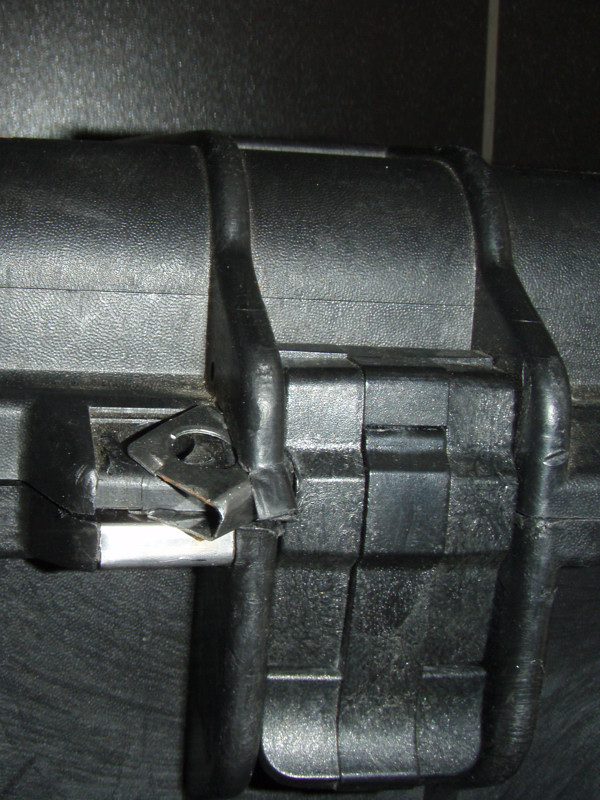
Some years ago, after having numerous suitcases damaged, I purchased a Pelican case. This came with a lifetime warranty against everything except "shark bite, bear attack and children under five"*. On their web site they had photos of Pelican cases which had survived being blown up in Iraq.

[* = Yes, they are one of those over-hyped American products, but they are still very tough for all that.]

I don't suppose they employ bears or sharks at QANTAS, so they must be using children under five, because the first time I took the case on a flight, it arrived damaged so badly that I had to borrow a screwdriver to open it.

Here is what they managed to do:

Exhibit A

It doesn't look so spectacular, but consider that the metal reinforcing for the locking point was torn loose and rammed so deeply into the side of the latching mechanism as to jam it solid. It wasn't possible to open the case by hand. It's a mystery how they managed to achieve this; it must have required considerable force. Did they place it against a sharp edge and jump on it? Did someone repeatedly hit it with a hammer?

In subsequent trips, the case acquired scratches all over, deep gouges in the top, and was sent to the wrong place on one occasion.

The check-in staff used to have a nasty trick they'd play on people.

"Is it fragile?" they would ask.

"Yes," you would reply, hoping to have your case spared the worst of the kicking.

"OK," they would say, "sign this."

And you'd be given a label to sign waiving your rights to claim damages, because your property was "fragile and improperly packed". Checkmate, sucker!

The abuse of baggage, however, is actually one of the least bad aspects of airline travel these days.

I use to be strongly loyal to QANTAS, but now I alternate between airlines. I try QANTAS and they piss me off so much that I vow never to fly with them again. So I travel Virgin. Virgin then manage to piss me off even worse and I think QANTAS weren't so bad after all. So I go QANTAS next time, whereupon they find some new different way to annoy me.

At this stage the reader is probably thinking "First World Problems", and for sure I'm appreciative of the fact that I have (at least currently) safe and (moderately) convenient air travel available at a reasonable price. Nevertheless, the point I want to make is that things are unnecessarily and artificially bad and this is symptomatic of a worse underlying problem. Things could be (and were in the past) so much better.

It seems that both major airlines are engaged in a classic race to the bottom. Dishonest and deceptive practices are the norm. Staff are mistreated. Customers are a fungible commodity - eleven dollars made by annoying and ripping off a (previously) loyal customer is better than ten made by treating them decently.

A couple of examples:

1) Low cost air fares cannot be changed on line, but instead you have to ring them up to do this. Since they already have to set up the software to allow the more expensive fares to be changed, they could do this for cheaper fares at zero cost. Instead they have to spend extra money to employ people to handle the calls.

This is bean-counter logic. You actively spend money to give people on cheap fares a worse experience, in order to make those on the more expensive fares feel like they're getting something extra. It's the sort of thing that no one with a conscience would even think of, but it's more cost-effective than providing value for money, and that's all that matters.

2) Then there are tricks with extra baggage. If you want to take a second piece of luggage, it has to be booked separately, and rather than an endorsement on your ticket, you get sent a separate receipt by email which you have to print out (and it's not even a PDF, just to make printing harder). Sometimes - and this has happened to me - they "forget" to send the receipt and you have to ring them up and hassle them about it. It's all about tricking the careless (and we're all careless sometimes) into not bringing the receipt with them to the airport, so they have to pay again, at an even higher rate, for their baggage.

Naturally people complain and I'm sure they get their money back eventually, but meanwhile QANTAS essentially have an interest-free loan of your money. Again, appealing to the bean-counters. Of course the check-in staff have to bear the wrath of angry customers, but that doesn't appear on the balance sheet.

I could go on here and bore you with a list of further petty grievances: crowded seating, check-in Nazis with idiosyncratic ideas of what may be allowed in baggage, meals which exemplify the term "all sizzle and no steak", frequent-flier programs now rendered a joke, the high incidence of cancelled flights, peculiar pricing policies which often make it cheaper to forfeit a flight rather than rebook, and of course the ever-present Security Theatre, which is just as much a farce as ever. [And to be clear, these complaints apply equally to QANTAS, Virgin and Jetstar.]

What really concerns me, however, is that aircraft maintenance has not been exempted from this mania for sacrificing everything in the pursuit of the short-term Dollar. We are seeing yet another round of job cuts to engineering staff in QANTAS.

My understanding is that modern aircraft are like modern cars: they are safer and require less maintenance than previously. Paradoxically, this can be dangerous because it gives an excuse to cut back on maintenance and you can get away with more for longer before a real disaster happens. I have zero confidence that the heavy-handed industrial relations attitude of QANTAS is in proportion to any reduced demand for maintenance.

Friday, 9 May 2014

In defence of 419 scammers

I'm sure you've all had those emails from the widow of a Nigerian general who wants your help to get US$120,000,000 out of the country, and is willing to let you keep 10% for your trouble. Don't they just suck, and it isn't it terrible when people get taken in and lose all their money?

Some time ago, I stumbled upon a scam-baiting site; a place where people work together to get their own back on Internet scammers of this type. At first I was pleased that some effort was being made to stamp out this menace, but the more I read, the more I felt that something wasn't quite right. I first became worried, then horrified at what was going on. It certainly changed my perspective on the matter.

Before I write further on this, let me digress with a little imaginary scenario.

Imagine a place where there are two rival groups, let us for sake of neutrality call them the Silvers and the Golds. These groups are frequently in conflict and fatalities often result on both sides. The Silvers are distinguished by their use of blunt weapons; clubs, baseball bats, tyre irons and so on. By contrast the Golds always use edged weapons; cut-throat razors, knives, etc.

So far so bad: It isn't obvious whether being clubbed or being stabbed is worse. Both can hurt or kill you. They are by no means identical in their effects and it might be that under certain specific conditions one method of attack might be considered significantly worse, or more immoral, than the other. Nevertheless a sensible person would say that there's essentially nothing in it; being stabbed and clubbed are both are really bad things.

Now let us say that we are constantly regaled by sensational stories of people (invariably Silvers) being shivved and bleeding to death. Every time someone (invariably a Gold) sticks someone, it is reported in gory detail. Much is made of the pitiful suffering of the victim.

Societies band together for the banning of knives and the compulsory use of safety razors. Vigilante groups form to lynch anyone caught with a blade.

Meanwhile, clubbings go unreported and are ignored. Silvers take pride strolling around with clubs stuck in their belts, those who wield the biggest clubs are honored. Skill in the art of clubbing (but only for legitimate defensive purposes, of course) is considered to be the foremost determinant of a person's worth.

Now if you to complain to an anti-knife society about this situation, they would quite reasonably reply that it isn't their job to fix all of society's ills. After all, a cat shelter could not be considered hypocritical for ignoring abandoned dogs.

They would go on to say, also quite reasonably, about how knifings and slashings are a very terrible thing. They would truthfully say that it's not a good thing to have knife merchants skulking around looking for someone to stab. They would ask (probably sarcastically) whether you were wanting anti-knife societies to disband and thus allow stabbings to continue unchecked.

They would most vigorously claim not to be biased against Golds. They would never mention the word Gold when talking about stabbings (and would strongly censure one of their own for doing so) and they would certainly never claim that a Silver caught stabbing someone would be any less liable for retribution than a Gold. And this would not simply be window-dressing to obscure their real motivations, but would be something they genuinely believe.

"Yes, we agree it's also a terrible thing when someone who doesn't deserve it gets clubbed, and we also agree that clubbing can be every bit as bad as stabbing, but," they would conclude, "it's a free country; you can go form your own anti-clubbing society if it's a concern to you."

They would be saying nothing that's false or even unreasonable. Yet, when the clubbings outnumber the stabbings a hundred to one, and are punished by a limp slap on the wrist (if at all) - and when it's considered taboo and border-line subversive to mention this fact - the presence of a well-resourced anti-knife society exacting unusually harsh justice against knifers can't really be something to feel happy about.

Now let us return to the real world.

Consider the history of Africa: Slavery, massacres, the Belgian Congo, Apartheid, and God knows what else, going back centuries. Much of the wealth in Europe was plundered from its African colonies. Much of the wealth of America was derived from slaves kidnapped from this continent.

This sort of stuff hasn't just stopped. There are still massacres and genocides. Slavery still occurs; both literally (in terms of illegal human trafficking) and in terms of widespread exploitation of people; which is slavery in all but name. Who is it who sews your clothes or puts together your iPhone or digs your diamonds out of the earth for a pittance? Are they really any better off than slave labourers on a 19th century cotton farm?

Rich multinational companies have more power than poor African countries. By threats and bribery, a multinational can steal billions from an African country with impunity.

In my imaginary tale above, we can quite legitimately make the following substitutions:

    "Gold" = Poor Black
    "Silver = Rich White
    "knifings" = Taking money by 419 scams
    "clubbings" = Taking money by other dishonest means

But in actual fact, the real situation is even more unfair. Those billionaires exploiting third-world countries are amongst the richest in the world (apparently, the richest 84 people in the world have as much wealth as the poorest 3.5 billion). They are not in any sense of the word in need, yet they destroy the lives of tens or hundreds of millions of people simply to increase their wealth still further.

Now imagine, if you can, living in Nigeria. Although not the poorest country in the world, it is hardly a wealthy place and nearly all of this wealth is held by a small elite. For the majority, there are few opportunities. Even if you're smart and work hard you'll have a miserable life. You are surrounded by corruption, and the examples given by your government and by the rich white corporations who control your resources, is that it's quite normal to grab whatever you can by whatever means are available.

Would you consider it legitimate to use your skills to lift a bit of money off (comparatively) rich whites - and especially whites hoping to obtain unearned wealth by dishonest means - or would you take the more "moral" course of working around the clock sewing brand-name running shoes, in an unsafe factory for starvation wages?

I know what I'd do in those circumstances.

Now let use look at an exchange from the 419eater scam-baiter forum, a place which deserves to be named and shamed:
"I'm going to throw this out here, but, and no offence to the great baiters who have done this, Abeche is so... last year. I hear the new Abeche this season is Liberia. Liberia, where our lad has a pretty good chance of being executed by a 9 yo child soldier, is a great travel destination... though things have calmed down recently. "
...

"Yeah, Abeche has been done. It's greatest selling point was how far from anything it is. However, the thought of our lad being shot by a child soldier is delightful to me. Liberia is more accessible than Goma, Congo at the moment."
[That was in the context of a romance scammer who was being tricked into following his supposed victim around the continent.]

Read it again and consider it for a moment. Here are a bunch of well-off whites quite openly trying to get a black man killed, and they are gloating over the prospect. [And in passing, I note that that they don't consider the existence of 9-year-old child soldiers to be an abomination, but merely a useful tool in their sadistic games.]

By comparison, consider this; sometimes salesmen knowingly try to trick people into buying stuff they can't afford just in order to get a commission. Bankers can knowingly give people loans that they can't repay. People lose all of their money and get hopelessly into debt as a result. Both in terms of the morality of the perpetrator and the effect on the victim, this is in many ways worse than a 419 scam.

Should we therefore form societies to arrange for the murder of used car salesmen, bankers and so forth? It would only be fair.

So, as usual, I've laboured my point excessively, so let me just conclude by saying:

Scam-baiters are cowardly lynch-mobs of well-off people who are unconsciously motivated by racism. By comparison, 419 scammers are simply doing what they can to survive and (in comparison) deserve your sympathy.

Monday, 28 April 2014

The Qantas apple

WTF is this? A "ready to eat" sliced apple in a plastic bag.


Aren't apples already "ready to eat"?

Sunday, 20 April 2014

Taking the Fuhrer's name in vain

I have a suspicion that the real reason people invoke Godwin's Law is that they are closet Fascists who consider any mention of their beloved leader's name to be blasphemy.

Apparently, if you call someone a Communist*, that's a perfectly legitimate criticism, whereas if you call them a Fascist you automatically lose because "Godwin's Law". That is to say, it's firstly a descent to a school-yard level of logic, and secondly it unfairly targets one side of politics.

[* = Recently however, the term "Socialist", or even in some circles "Liberal", seems to be taking over as a term of abuse, which is a very worrying trend.]

What I find interesting about the business is that whenever I have seen this law invoked (and it must run to the hundreds by now), it has almost without exception been incorrectly applied. There must be some selective blindness at work, because I have seen people cut-and-paste the wording of this law into a post without realising that it completely contradicts their use of this law.

Godwin's Law in no way prohibits the use of any words. It is not a law in the legal sense ("you must do this"), but instead a law in the scientific sense ("this is true"). In its original form it goes as follows:
"As an online discussion grows longer, the probability of a comparison involving Nazis or Hitler approaches 1."
In other words, it states that over time, discussions tend to degenerate into name-calling and hyperbole. Which is a perfectly valid observation.

You can see how the law was intended to be applied: If, for instance, a discussion on the relative merits of different game consoles reached the point where people were calling each other Nazis (a thing likely to happen relatively quickly), it would be fair enough for someone to cry out "Godwin's Law", as a short-hand way of saying "this discussion has now descended to the point where rational debate is no longer possible and therefore it should be abandoned".

The difficulty I have is that this law is also used to stifle legitimate political discussion. Nazism and Fascism are not isolated phenomena belonging entirely to the past. People don't actually call themselves Nazis or Fascists any more, but the fact is that the same sorts of people, with the same sorts of motivations, are saying and doing the same sort of things today - to the extent that things are getting actually frightening.

You can point out, giving specific examples, where the behaviour of some political figure mirrors that of Hitler or Goebbels, and then some arsehole can arrogantly dismiss your whole argument (without having to counter any of the points you've raised) with the line: "Bzzzzzzzzzt. Godwin's Law. You Lose."

For sure, the vast majority of the time someone gets compared to a Nazi, the comparison is not valid. E.g.:
"I think euthanasia should be legalised"
   
"Isn't that what the Nazis did?"
or
"I believe in stricter firearms laws"
   
"Hitler brought in stricter firearms laws"
But that's only because debate on the Internet is usually at such a low level that the vast majority of the time any one line rebuttal is logically flawed. It's the same principle as Sturgeon's Law**.

[** Supposedly someone said to science fiction writer Theodore Sturgeon "90% of science fiction is crap" and Sturgeon replied to the effect of "True, but that's because 90% of everything is crap".]

Now consider this exchange:
"Taking aspirin to reduce a fever is counterproductive, because a fever is the body's way of fighting off invading microbes. In this case it's better to leave your body alone to look after itself."
"Isn't that what a Christian Scientist would say?"
You wouldn't argue that a comparison to a Christian Scientist violated some particular law and that this in itself invalidated their statement. You'd probably reply something along the lines that in this case the Christian Scientist would be right despite themselves and that this was irrelevant to the argument you were making (or more succinctly: "a stopped clock is right twice a day").

If a comparison is invalid or irrelevant, you can simply say that it is invalid or irrelevant. Similarly, if a debate has degenerated to name-calling, you can say that it has degenerated to name-calling and therefore should be abandoned. Godwin's Law is neither necessary nor sufficient to address these issues.

So I suppose all of this is a long-winded way of saying that I think Godwin's Law has outlived its usefulness and should be retired.


[Update 17th August 2017 - it seems that Mike Godwin himself has come to the same conclusion and writes: "By all means, compare these shitheads to Nazis."]

Tuesday, 1 April 2014

It is un-Australian to worship the Australian flag

I saw this obnoxious thing on someone's car at the local shopping centre recently. [Edit: I should add  that despite the date of this post, this is not an April Fools joke; sadly it is real.]

Flag-worship is un-Australian, as is ordering people around like a freaking Dalek.
 
I can understand why certain people have an attachment to the flag of their country.

Imagine you are a soldier fighting a battle. Suddenly a large number of armed men start coming towards you. They may be the enemy and you may be about to die. If the flag of your country suddenly appears over these soldiers, it will become the most beautiful thing in the world at the moment. If you have a flag of your own, you'll be waving it over your head frantically, since your life may literally depend on doing this.

By the end of the war, it is easy to imagine that this behaviour has embedded itself at a deep emotional level in a soldier's subconscious - even without the help of the ceremonies and other rituals they take part in. The attachment could be so deep that a person might get misty-eyed at the sight of their flag, or homicidal at the thought of someone "disrespecting" it.

In other words, flag-worship could be thought of as a pathological condition caused by a traumatic experience.

Edgar Rice Burroughs - the author of Tarzan - wrote a novel called The Red Hawk. Like most of his work, this was a simplistic, action-packed tale of goodies versus baddies and (apparently) not intended to be a social commentary. However it featured the interesting concept of "The Flag" (the Stars and Stripes; naturally enough) actually being worshipped as a deity in itself. Thus characters would say things to the effect of "When The Flag created the world..." and "The Flag will be angry if you do that". I found this much more amusing than it was probably intended to be.

The worshippers of The Flag were, naturally enough, a fierce warrior tribe engaged in a generations-long war. Although fictional, the scenario made sense; if a people have endured an invasion or a civil war, they may be traumatised in the same way as an individual soldier, and their resulting psychoses (including flag-worship) may become part of their national character.

So it would fair enough to say that a flag may have great importance to those on both the giving and receiving ends of militarism.

Australia, however, fits neither of these categories.

Consider ANZAC day; the primary military-related event on the Aussie calendar. It was originally to commemorate the Gallipoli landings. There is much (perfectly legitimate) talk about bravery and sacrifice and so forth, but no one can say that Gallipoli was being celebrated. It wasn't glorious and it wasn't a victory. It was basically a disaster. We lost and had to run away.

ANZAC day is also unusual (and possibly unique) as far as such events go in that it's about both Australians and New Zealanders. It's not a nationalistic thing.

Australia's military heritage consists pretty much entirely of getting dragged into other people's wars (and generally losing*). The only exception was defending against Japanese invasion in WW2, and that was forced on us.

[* = Not necessary because we're incompetent but generally because we get thrown into unwinnable conflicts. I'm not sure whether this makes it more or less humiliating.]

While there's a general belief that Australians punch above their weight in warfare (but don't all countries think that about themselves?), we don't glory in fighting. It isn't part of the national character to think that it's wonderful to go around invading other countries. We don't parade our missile carriers (do we even have any?) through the streets, followed by ranks of goose-stepping soldiers. We aren't militarists, and we haven't suffered invasion, civil war or revolution either. We don't need a flag to cling to, and we should be glad about this.

Now let us look at the flag itself: It is ugly, both visually, and symbolically.

First of all, the Union Jack in the corner is an irrelevant relic of a fairly unpleasant colonial past. Australia was a prison colony. It was taken from its original inhabitants by the British without even the pretence of a treaty. Nothing to be proud of. Moreover, the United Kingdom has very little relevance to modern day Australia (we play cricket, and that's about it).

The Southern Cross is hardly uniquely Australian either; it's visible in all parts of the Southern Hemisphere, and a little way into the Northern. It could equally well be used by perhaps half of the countries in the world.

Symbolically, the Union Jack consists of the crosses of St George, St Andrew, and St Patrick. The Australian flag adds the constellation of the Southern Cross. That is to say, four crucifixes on the one flag. According to a recent WIN-Gallup poll, Australia is one of the top 10 atheist countries in the world. Isn't a flag consisting almost entirely of crucifixes just a little bit inappropriate?

The construction of the flag is also awkward. Aesthetically, the Union Jack looks fine by itself, and the Southern Cross doesn't look bad either (although having stars on a blue background is arguably illogical; at least PNG chose a black background for their Southern Cross), but the two don't go together. By contrast, the Aboriginal Flag is simple, distinctive, and with a choice of colours that not only look good in themselves but also are symbolic of the country**.

[** = I'm not saying that we need to appropriate the Aboriginal Flag; I think that would be unacceptable to both black and white unless a lot more reconciliation takes place. I'm just saying we don't have to look very far afield to find a better flag.]

Don't get me wrong here: I'm not campaigning for a new flag. Our flag is ugly and stupid and in an ideal world we'd have something better, but this is so unimportant compared to all of the other problems we're currently facing that we might as well not bother. And if it's going to upset a few service-people, why create unnecessary pain for very little gain?

Nor am I saying someone shouldn't be allowed to bow down before their flag if they want to. Put a sticker on your car that says "I love this flag" and I won't complain.

But what does concern me is that this person - and there are more like him appearing all the time - feels he has to right to aggressively order me to join him in his psychotic beliefs, and apparently I must either obey him or get out. That is un-Australian.