Sunday, 14 February 2016
Synthetic Food for Valentines Day
This is a coconut and white chocolate panna cotta made with agar.
The cherry at the bottom is not a cherry at all, but a pearl created by reverse spherification, filled with hibiscus syrup.
At the very bottom is a single synthetic caviar sphere produced by normal spherification. See my post from last year on this subject.
It was all delicious - if I do say so myself.
This dessert was based on a recipe on the Flavor Bender site.
With the panna cotta I followed the recipe fairly closely. I halved the quantities, substituted thickened cream for the half-and-half and agar for the gelatin. I used 0.75 g of agar powder, which is the bare minimum needed to hold the panna cotta together. Apparently this is how a panna cotta is meant to be, but it makes it really difficult to work with. You need to turn it out really gently on the plate and you can't move it around afterwards. Here's a photo of the same recipe using twice as much agar (1.5 g). The panna cotta still tasted good and was firmer and easier to work with, but the softer textured one was definitely better.
For the pearls, I used the syrup from a jar of Wild Hibiscus Flowers in Syrup instead of brewing an hibiscus tea, but otherwise followed the recipe closely. These Wild Hibiscus Flowers, by the way, are intended for dropping into a glass of sparkling (aka champagne) and if you haven't had these before I'd highly recommended trying them.
When I made the synthetic caviar (I made a whole lot more than the single ball shown), I used calcium lactate instead of calcium chloride in the setting bath just to see what it was like. You need to use twice the quantity (by weight) and it's a little more difficult to dissolve, but it makes a noticeable improvement to the flavour and I'll be using it from now on. With the calcium chloride, the caviar has to be washed thoroughly to remove the salty flavour imparted by the chloride, and often some saltiness remains. The lactate, by contrast, is virtually flavourless.
Tuesday, 26 January 2016
In defence of Australian Animals
![]() |
| A typical fierce Australian animal, ready to hurl itself at an unsuspecting victim. |
I don't think Terry Pratchett started the myth that the Australian continent is packed with deadly creatures, but he must surely share some of the blame for popularising this idea.
Death held out a hand, I WANT, he said, A BOOK ABOUT THE DANGEROUS CREATURES OF FOURECKS—
Albert looked up and dived for cover, receiving only mild bruising because he had the foresight to curl into a ball.
After a while Death, his voice a little muffled, said: ALBERT, I WOULD BE SO GRATEFUL IF YOU COULD GIVE ME A HAND HERE.
Albert scrambled up and pulled at some of the huge volumes, finally dislodging enough of them to allow his master to clamber free.
HMM . . . Death picked up a book at random and read the cover. DANGEROUS MAMMALS, REPTILES, AMPHIBIANS, BIRDS, FISH, JELLYFISH, INSECTS, SPIDERS, CRUSTACEANS, GRASSES, TREES, MOSSES, AND LICHENS OF TERROR INCOGNITA, he read. His gaze moved down the spine. VOLUME 29C, he added. OH. PART THREE, I SEE.
He glanced up at the listening shelves. POSSIBLY IT WOULD BE SIMPLER IF I ASKED FOR A LIST OF THE HARMLESS CREATURES OF THE AFORESAID CONTINENT?
They waited.
IT WOULD APPEAR THAT—
'No, wait, master. Here it comes.'
Albert pointed to something white zigzagging lazily through the air. Finally Death reached up and caught the single sheet of paper. He read it carefully and then turned it over briefly just in case anything was written on the other side.
'May I?' said Albert. Death handed him the paper.
' "Some of the sheep," ' Albert read aloud.From Discworld 22 - The Last Continent [Terry Pratchett, 1998].
Australians promote this fiction probably because it implies they are a hardy breed of Crocodile Dundees, contemptuously shrugging off fearsome beasts daily. In actual fact, Australians are by and large a bunch of spoilt wimps* liable to run away in fear from a tiny sugar glider.
[* = I exclude from this criticism Aboriginal people living in the Top End who share swimming holes with salt-water crocodiles.]
Let us have a look at what the continent has to offer.
Consider Dorothy's fearful exclamation in the Wizard of (ironically) OZ; "Lions and Tigers and Bears! Oh My!".
Australia has no lions or tigers or bears - or even any other large carnivores that are in any way comparable.
Every other continent, with the exception of Antarctica (and even that has leopard seals), has more in the way of large carnivores. In addition to the lions and tigers and bears, other continents also have cheetahs, leopards, jaguars, mountain-lions, wolves, hyenas and so on; a whole assortment of large and dangerous meat-eaters you wouldn't want to meet on a dark night.. Even an animal like a baboon could make a mess of someone. There are also megafauna; elephants, rhinos, hippos and so forth, which, although vegetarian, are quite willing and able to kill a person.
By contrast, Australia has only one single animal in this category; the salt water crocodile. They don't even grow as big as Nile crocodiles and they mostly inhabit remote places where comparatively few people go. A bear is smart and can actively hunt a person, whereas a crocodile has a brain that would easily fit into a matchbox and is a creature of instinct. Getting chomped by a crocodile is like falling into a hole in the ground or walking onto a road and getting hit by a truck; it's largely your own fault for incautiously going somewhere you shouldn't be.
There are dingos. Dingos are just dogs, and smaller and less dangerous than many domestic breeds. A starving dingo may under exceptional circumstances take an unprotected baby, but a rottweiler can easily kill an adult human. And there's no rabies here to worry about either.
We're even under-represented when it comes to small carnivores. What do we have to match a honey badger or a wolverine, or even a ferret? At best we have a Quoll; less dangerous than a cat and teetering on the edge of extinction.
Tasmanian devils sound fierce enough (both in terms of the name and the actual sound they make), but are primarily scavengers that these days mostly eat road-kill. I suppose one could give you a good biting if you tried to pick it up, but so could a poodle.
Supposedly a Cassowary can kill you. Total death toll by cassowary: one 14 year-old boy who was trying to club the bird to death and got kicked in the neck for his troubles, severing a carotid artery. I'm not sure it's fair to brand the bird a killer when it was acting in self-defence.
An emu can peck and scratch, but is smaller and less aggressive than an African ostrich. Ostriches kill many people a year in Africa.
Obviously you can still be bitten by a wombat or a koala and even a sugar glider can draw blood, but it's stretching it to say that they are in any way dangerous.
What about the nasty, toxic, creepy-crawlies?
Native wasps are less dangerous than the European wasp and pale in comparison to monsters like the Japanese Giant Hornet.
Native bees don't even have stings and are harmless. Other places have to contend with Africanized "killer" bees.
We have large bull-ants which can hurt when they bite, but nothing like army ants that attack in the millions and can strip you to a skeleton.
Native scorpions are small and only weakly venomous. Only one person has ever died from the sting of an Australian scorpion, and that was a baby who was only assumed to have been stung - no scorpion was actually found.
No native amphibians are noticeably toxic. There's the introduced cane toad, which I'm not sure should really count, but that's only a threat to native animals and in no way dangerous to humans (unless you literally milk the venom and eat it). We don't have specimens as toxic as the poison dart frog, nor can we boast a creature like the Horror Frog, which breaks the bones in its feet to form claws for defence.
What about Snakes? Surely we've got a lot of venomous snakes!
In terms of venom toxicity, Australian snakes are indeed considered to be the most toxic in the world. I think this is to a degree an artifact of the testing process. Snake venom toxicity is determined by testing on rats and mice. Most Australian snakes prey on small mammals like rats and mice, and it would make sense that their venom is more toxic to creatures of this type.
But whatever the truth, being more toxic does not make them more dangerous. After all, botulism toxin (botox) is the most toxic chemical known, but people happily inject it into their faces.
Consider the "number one most venomous snake in the world", the Inland Taipan: Yes its venom is 50 times (or whatever the figure is) as powerful as that of a cobra, but this snake has never killed a single person.
Australia has between 2 and 4 snake bite deaths per year. This is less than any other continent (barring, as usual, Antarctica), and pales into insignificance against India where over 10,000 people die from snake-bite per year.
There are pythons. They can grow fairly big and occasionally someone's chihuahua gets eaten. I suppose a really big one might be a threat to a child. However, we don't have the big reticulated pythons of Southeast Asia or the anacondas of South America that can eat an adult human. Total human fatalities by python in Australia: zero.
Yes, there was the YouTube video a couple of years back of a python eating a crocodile near Mt Isa. What wasn't obvious was that it was only a 1 m fresh-water crocodile, and even then the snake took several hours to subdue it. Hardly a battle of the titans.
Other reptiles? A thorny devil looks a little scary, but is totally harmless (although I suppose it might hurt if you stepped on one with bare feet). By contrast, the equivalent American creature, the Horned Toad can squirt blood at you from its eyes.
A big goanna can hurt if it bites, but is nothing compared with the Indonesian Komodo Dragon, which weighs as much as a person and eats goats.
[BTW, that's enough with the links; you can type names into Wikipedia as easily as I can.]
Spiders?
Australia is supposedly overrun with huge, deadly spiders, but this too is a myth.
The largest (by weight) spider in the world is the Goliath Bird-Eating spider. This is a South American spider.
The largest (by size) is the Giant Huntsman, which comes from Laos.
The most deadly is the Brazilian Wandering Spider, which, naturally enough, comes from Brazil.
None of these are found in Australia.
Of the ten largest species of spiders, only one or arguably two, is found in Australia. There is the Golden Orb Weaver - one of the least scary looking spiders - and (arguably) the Huntsman. I believe that top-ten lists which include the Huntsman are in fact referring to the Giant Huntsman, and not the comparatively smaller species which live in Australia.
In terms of scariness, I suppose it's more subjective, but you'd be hard pressed to beat the Camel Spider (do a Google Image search if you dare). These abominations are found on every continent except Australia and (yet again) Antarctica.
Of the ten most dangerous species of spider, only two are found in Australia.
There's the redback; it's the same thing as the American Black Widow, and there is also an equivalent species found in Europe (the Mediterranean black widow), so it's not unique to Australia. It's a shy and retiring creature and only weakly poisonous. Most people bitten don't even require treatment. How many people have been killed by a redback? They say no one has died since an anti-venom was developed in the 1950s, but I have been unable to find any evidence of deaths even prior to that date.
Then there's the Funnelweb. It certainly looks scary and it's more toxic than the redback, yet the chance of death from even an untreated bite is estimated at much less than 1%. Note the word "estimated"; in reality no one has died from a bite in so long that it's difficult to determine.
Sea Creatures?
Certainly there are plenty of dangerous animals in the ocean, but none of these are unique to Australia. Box jellyfish, stone fish, sea snakes, stingrays etc. are found right through the tropics. Blue-ringed octopuses are found as far away as Japan. Everywhere that has coastline has sharks.
Anything else?
Do we have anything like a piranha? Nothing close, not even a Snapping Turtle.
Vampire bat? Nope.
Electric eel? No way.
There's the platypus, the male of which has venomous spurs on his hind legs. The venom appears to be formulated to cause pain to an attacker rather than kill prey, and is not considered to be lethal to humans. Most Australians have probably not even seen a platypus outside of a zoo, so getting spiked by a platypus is hardly a common hazard.
A kangaroo can kick you. Some kangaroos are very large and they obviously have very strong legs, so a kick could no-doubt injure a person, but your average farm animal can do much worse. A good kick in the head from a horse can easily kill a person, and I believe horses cause more fatalities per year in Australia than any other animal.
In conclusion:
- There are whole categories of deadly animal which are not found in Australia.
- For every deadly animal that is found in Australia, there's something at least as bad, and usually much worse, elsewhere in the world.
- The number of deaths by (non-human) animal in Australia are extremely low compared to most other countries.
- Most Australians go years at a time without even seeing a dangerous native animal.
This "everything'll kill ya, mate" business is a great big lie.
Wednesday, 9 December 2015
I'm not a radiophobe but... [Nuclear waste in Australia]
Recently, while out shopping, a Courier Mail* headline shouted out at me the words:
This was puzzling to me because there are already a number of radioactive waste dumps in Australia, and moreover, one of them is only about one hour's drive from Brisbane. It's known as the Esk Storage Facility and it's located in a pine plantation about 10 km to the west of the town of Esk.
Here's a photo of it:
And a picture of it from Google Earth:
This is a state government facility built in 1994 and it mainly holds old medical radioactive sources.
This place is located in the catchment area of the Wivenhoe Dam (the largest of the dams which provide Brisbane with its water). According to our elected representatives, this is not a problem:
Unfortunately, this statement is untrue [as a general rule, you can assume that when a politician launches into a withering attack like this, they are not telling the truth]. By far the greatest proportion of the radioactive waste (approx 87% as per a report by the ARPANSA [Australian Radiation Protection and Nuclear Safety Agency]) held at this site is caesium-137. Caesium-137 is normally present in the form of caesium chloride; which is highly water soluble. It is true such sources are hermetically sealed, however an accident that allowed such a source to get free could quite easily rupture the relatively thin encapsulation.
Fortunately this fact was realised because (according to the 1996 federal senate enquiry "No Time To Waste" ) radioactive waste delivered to the Esk facility now takes a longer route around the dam to avoid passing over the dam wall.
I suppose it should go without saying, but radioactive waste is very nasty stuff.
Consider caesium-137; the stuff mentioned above. It's produced in large quantities in nuclear reactors. It's a major component of the fallout from Chernobyl and Fukushima. It's also used in medicine where its intense radiation is used to destroy cancer cells.
In 1987, there was an accident involving a medical Caesium-137 source. This was known as the "Goiânia incident", and it's documented in quite a bit of technical detail in a report put out by the IAEA [International Atomic Energy Agency].
[Incidentally, there are a number of incident reports of this type put out by the IAEA and they make fascinating reading, although be warned that in places there are photos of horrible radiation injuries that will turn your stomach.]
The story goes as follows:
In 1987 a radiotherapy source containing approximately 31 cc (that is to say, slightly less than a shot-glass full) of caesium-137 chloride, was disassembled by a scrap metal merchant in the Brazilian city of Goiânia.
Unfortunately, in the words of the report, the following happened:
There was a prolonged and laborious cleanup, during which approximately 3500 m3 of radioactive waste was removed from the area. This didn't even clean up all of the contamination (approx 14% was not accounted for), but merely brought radiation levels down to levels where people could safely move back into the area.If my calculations are right, this is over 100 million times the volume of the radioactive material that caused the incident.
This gives some perspective on just how potent the stuff is, and just how difficult cleaning up after an accident can be.
It is not at all "radiophobic" to be scared of this shit.
This all said, I'm not lying awake at night worrying about the Esk facility. You have to stick this waste somewhere and a purpose-built facility like this is probably your best option.
Interestingly, there's actually not so much waste in the place. According to the ARPANSA report I quoted earlier, there's only a total of 5.3 TBq of total radioactivity stored there, which is a bit over 1/10th of the amount that was in the Goiânia source. [Why so little? I'm assuming it's because the really big radiotherapy sources are all still in use; caesium-137 has a half-life of a fraction over 30 years, so they're good for a long time and they're not something you'd throw away lightly.]
More interestingly, there is another place close to Brisbane that contain much more radioactive material. This is the Narangba Food Irradiation Plant, which is located 30 km North of Brisbane.
According to a conference paper by the Australian Nuclear Association this facility was designed to accommodate up to 185 PBq of cobalt-60, although it was initially only loaded with 11 PBq. I haven't been able to determine whether the facility has subsequently been loaded up closer to its full capacity, but even 11 PBq is a lot; it's a bit over 2000 times as much activity as is in the entire Esk facility. At full capacity, that would increase to nearly 35,000 times.
Cobalt-60 has a half-life of a bit over 5 years, so the source elements have to be replenished regularly. I'm assuming they get their cobalt-60 from the Lucas Heights reactor, which means the replacement source elements have to be trucked right up the coast, through both Sydney and Brisbane. [I'm not sure what becomes of the depleted sources, they can't be going to the Esk facility because this only holds a total of 470 MBq of cobalt-60, which is far less than even a single source element. Presumably they currently keep them on site, although eventually they'll need to be disposed of.]
I'm not sure how worried we need to be about this, though. The source elements consist of pellets of metallic cobalt (which is chemically a fairly inert material), doubly encapsulated in stainless steel, so there's much less chance of widespread contamination occurring in the event of an accident than with some other isotopes.
I'm sure that there are extensive safety precautions taken during both the transport of the source elements and the operation of the plant itself...
Then again there's a saying that goes "you can't make anything truly foolproof, because fools are so ingenious". And this is amply borne out by a fatal accident that occurred in the Nesvizh Irradiation Facility in Belarus in 1991 [which at that point was the fifth fatal accident to happen in an irradiation facility].
These places have some pretty fierce levels of radiation going on. A person would be subject to a lethal dose of radiation in approximately 30 seconds inside the irradiation chamber of such a facility. Consequently, there are some pretty elaborate safety precautions taken. Although there's a tendency (fostered by decades of cold war propaganda) to assume that in the old Soviet Union safety standards were lax and workers were incompetent, neither were the case here.
The operator who died was considered to be the most experienced operator at the plant. He had an engineering degree and had worked at the plant since its construction. He had had to pass a yearly examination on plant safety in order to retain his license to operate. This is a much higher level of both qualifications and experience than you'd find in the average Australian operator.
The entrance to the irradiation chamber consisted of a corridor with three separate right-angle bends in it (this was referred to as a "maze"). This was to ensure that there was no possibility of the radiation inside (which travels in straight lines from the source) getting out. At the entrance to this maze was one of the most unusual safety features that I've heard of; a pit trap in the floor(!). There was a cover over the pit which was extended or retracted by an electric motor, and this this was interlocked, via a key mechanism, with the source in the chamber; basically you couldn't extend the cover over the pit unless the source was lowered into a safe position.
Beyond the pit was a pressure plate on the floor, which would automatically drop the source to a safe position should someone walk over it. There were also gamma ray monitoring probes at various points and several emergency stop buttons. The mechanism for raising and lowering the source was of course fail-safe, with the force of gravity returning the source to its safe position.
As to what went wrong, the report states diplomatically:
It's not clear whether he actually pressed the "source down" button (possibly he meant to but forgot), however he left the interlock key in the panel. This meant the pit was still open, but rather than return to retrieve the key, he used the electric motor that activated the cover as a stepping stone to get over the pit.
Investigators were unable to determine how he managed to get past the pressure plate without activating it (apparently, even taking a flying leap over it would have been very difficult), or if he did activate it, how the source subsequently managed to raise to the active position (and if so, how he failed to hear this happening).
He then failed to look at the portable radiation monitor he carried with him before entering the chamber. You'd almost want to conclude that he was committing suicide, however after about a minute in the chamber he noticed the source was up and ran out calling for help.
It's not a laughing matter, but I have a picture of the guy, fighting his way, Indiana Jones style, past safety feature after safety feature to get into the chamber.
But that's what human beings are like, and why you should never trust anyone who says that some inherently dangerous technology can be rendered 100% safe.
But I'm not lying awake at night worrying about the Narangba Food Irradiation Plant either. It's unlikely that any accident would result in widespread contamination. If someone does something excessively foolish working in the plant, they'll probably die an unpleasant death, but in the overall scheme of things, that's no worse than falling into vat of paint stripper, or any of the thousand other horrible ways people can die in industry.
[As to whether we need to be irradiating food, that's a different story.]
One thing that would make me lay awake at night - at least if I thought he could get away with it - is Malcolm Turnbull's apparent desire to create a dump in Australia to receive the world's nuclear waste. We are talking about high-level nuclear waste here, which is fiendishly difficult to deal with. So much so that no country in the world has yet created a permanent high-level nuclear waste dump.
Turnbull appears to be strongly pro-nuclear, more so than he publicly admits. I'm not basing this on his public statements because I don't trust anything he says - but more that he has appointed strong (and in my opinion one-eyed) advocates of nuclear power - Ziggy Switkowski and Dr Alan Finkel - to important positions.
Why he would talk about a National Nuclear Waste Dump is a puzzle. It goes against the statement I made in my last post - which was that he was purely a political creature and stood for nothing. No purely political creature would dream of mentioning a National Nuclear Waste Dump; this idea has been under consideration on and off since at least as long ago as 1978, been subjected to committee after committee and report after report; and has ended up in the too-hard basket each time. [To make it clear; only the idea a national dump for waste existing within Australia was being considered. Until now no one had suggested taking waste from other countries.] Politically speaking, it's something to run a mile from. There are no winners - people are hardly going to thank you for not putting a nuclear waste dump in their back yard - and you're guaranteed to make some pretty strong enemies of those who draw the short straw.
Is he so full of himself that he thinks he can get away with it? If so, isn't that a terrible indictment of the man that the one issue he feels strongly enough about to spend his political capital on is the construction of a nuclear waste dump?
Or is it that he hadn't really meant to make a big issue of it, and it was blown out of proportion by Murdoch's gnomes in order to undermine him? This would also explain why the Mal Brough scandal just happens to be coming to light now, years after the actual event, and why the media are only now starting to question Mal's handling on the NBN. It does seem that certain elements of the media [and not just the cartoonists] are heartbroken at Abbott's departure and want him back.
But let's not get side-tracked...
A few days ago (5th Dec 2015) there was a shipment of nuclear waste into Australia. The story was that used nuclear fuel from from Lucas Heights had been shipped to France to be reprocessed and we're now getting it back. Basically, the French extract the plutonium and uranium (or as much of it as they can get) out the for their own purposes, and send us back the rest. [Actually, it's not quite as simple as this; they don't actually segregate the waste country-by-country, but simply send us back an equivalent quantity of waste from their stockpile.]
ANTSO [the Australian Nuclear Science and Technology Organisation] has put out a press release about this. It was full of pap to placate the proles. One thing that particularly caught my eye was this section in their FAQ. Let's play "Spot the Falsehood":
The second sentence starts with "Intermediate-level waste..", which we will see later is an incorrect categorisation.
The second sentence ends with ".. Only harmful if not managed properly.", which is classic weasel-wording. Think about it: this statement is always true by definition. If something causes harm then you're not managing it properly. Even something that's extravagantly dangerous is "only harmful if not managed properly". That it might be incredibly difficult to manage properly, and have terrible consequences if you don't, is a different issue.
The third sentence starts "It does not generate significant heat ...". As we'll see later this is not true. It puts out nearly 1 kW of heat; enough to cook your dinner on (although I wouldn't recommend doing this).
The third sentence ends by giving the false impression that the stuff is only shielded "as a precautionary measure", implying that it barely needs to be shielded at all. [Edit - In fact, even the massive amount of shielding present - each container weights 112 tonnes and incorporates 200 mm thickness of steel, 67 mm of lead, plus a special neutron-absorbing resin - still results in an uncomfortably high level of radiation in the vicinity of the containers.]
As for being able to ".. walk around next to those containers without special protective equipment", that's technically true but... The radiation protection plan says that a person would be subjected to 5.0 μSv/hr working in the vicinity of these (heavily shielded) containers. That's around 30 times the background radiation level in Australia. If you were to work in this area 40 hrs/week 48 weeks/year, you'd be subjected to an annual dose of about 10 mSv. This is half of the maximum allowed annual dose for "occupationally exposed personnel" (but 10 times the maximum allowed for members of the public). Since in reality a person isn't going to need to be in this area for more than a few hours at a time, a couple of times a year, this is not at all a dangerous situation (at least assuming everything goes as expected). Nevertheless, it's somewhat disingenuous to imply that you can stroll around these containers with complete impunity.
[Edit: Oh yes, and the "without special protective equipment" is also a deceptive statement. Protective clothing protects you from contamination (which would not be an issue here unless the containers are leaking), but it does not protect you from radiation. Why? because the thickness of lead required to give a useful amount shielding from gamma rays is far too great to incorporate into protective gear. According to a document from Oak Ridge National Laboratory, even one inch thickness of lead would be barely enough to reduce the radiation levels above to background levels. Consequently, it is wrong to assume that there is no danger just because protective clothing isn't needed.]
It took a lot of digging to find out what's in this waste, but the truth is out there; in the form of a supporting document to the license application for building a store for this stuff.
Here's what we got for Christmas:
[They also state what was in the spent fuel we sent out, but I've omitted this for clarity.]
Our old friend caesium-137 is there: 25 times as much as the Goiânia source, and the French even did us a favour; we only got back a quarter of the caesium-137 we sent out. On the other hand, they gifted us 14 times the americium-241 we sent them (which is enough to make over a billion smoke detectors), so swings and roundabouts.
There's an absolute shed load of the equally dangerous strontium-90, and we've got back over a third of the plutonium we sent them.
The contents of the Esk repository are a rounding error compared to this (literally; they would at most affect only the last decimal place of all of these figures).
One thing that's interesting, is that they quote the heat output of this waste. This is actually an important factor because it's what separates High Level from Intermediate Level Waste, and it's one thing that makes High Level Waste difficult to deal with: you need to cocoon it in shielding to keep the radiation at bay, but this traps in the heat, and if you don't get rid of the heat, the temperature starts to rise and then bad things happen.
The stuff we sent out was putting out 2101 W of heat. The stuff we got back was putting out 950 W. The difference was almost entirely due to the lesser amount of caesium-137 we got back. Since spent nuclear fuel has all of the characteristics of High Level Nuclear Waste (but it isn't referred to as such, simply because it's not defined as "waste"), and what we got back puts out nearly half as much heat as the spent fuel (and would put out virtually the same if the French had given us back all our caesium-137 as they were entitled to do), how come this waste isn't classified as High Level?
I suppose it's just a matter of terminology, but it seems that people are going to great lengths to avoid calling a spade a spade.
Finally, I'll leave you with this comforting thought:
This waste is only a drop in the bucket compared to what we'd be seeing if Turnbull's dream came true. This was just the waste from a single 10 MW research reactor. The average power generation reactor is about 100 times the size of this and there are over 400 nuclear power plants in the world. They have many decades worth of waste stored away, waiting for someone to take it.
NUCLEAR BOMBSHELL[*= I don't read this paper, which is sensationalistic and puerile even in comparison to other Murdoch papers, but sometimes its headlines intrude themselves into my vision, and, as with a car crash, it can be difficult to look away.]
Australia's first radioactive waste dump proposed just two hours from Brisbane!
This was puzzling to me because there are already a number of radioactive waste dumps in Australia, and moreover, one of them is only about one hour's drive from Brisbane. It's known as the Esk Storage Facility and it's located in a pine plantation about 10 km to the west of the town of Esk.
Here's a photo of it:
![]() |
| The Esk Storage Facility Hey Guys, there's already a nuclear waste dump on Brisbane's doorstep! |
And a picture of it from Google Earth:
![]() |
| The Esk Storage Facility from above |
This is a state government facility built in 1994 and it mainly holds old medical radioactive sources.
This place is located in the catchment area of the Wivenhoe Dam (the largest of the dams which provide Brisbane with its water). According to our elected representatives, this is not a problem:
... We have heard such outlandish cries in the past few months that the district has now been branded because of a problem that is merely a figment of the imagination.[Hansard - QLD Legislative Assembly 10th Oct 1991]
And it would appear that these unsubstantiated emotional outcries have only just begun.
We had Esk Shire Chairman, Cr Jean Bray—in an effort to draw more attention—claiming that Brisbane's water supply was at risk. It shows how little she knows about the matter that is to be stored there.
The matter doesn't dissolve in water and is not affected by it in any way. The storage site in Brisbane went under in the 1974 floods.
There was also the claim that an accident while waste material was being transported across the dam wall could cause havoc. Why? It would merely sit on the bottom until it was located by monitoring equipment.
Unfortunately, this statement is untrue [as a general rule, you can assume that when a politician launches into a withering attack like this, they are not telling the truth]. By far the greatest proportion of the radioactive waste (approx 87% as per a report by the ARPANSA [Australian Radiation Protection and Nuclear Safety Agency]) held at this site is caesium-137. Caesium-137 is normally present in the form of caesium chloride; which is highly water soluble. It is true such sources are hermetically sealed, however an accident that allowed such a source to get free could quite easily rupture the relatively thin encapsulation.
Fortunately this fact was realised because (according to the 1996 federal senate enquiry "No Time To Waste" ) radioactive waste delivered to the Esk facility now takes a longer route around the dam to avoid passing over the dam wall.
I suppose it should go without saying, but radioactive waste is very nasty stuff.
Consider caesium-137; the stuff mentioned above. It's produced in large quantities in nuclear reactors. It's a major component of the fallout from Chernobyl and Fukushima. It's also used in medicine where its intense radiation is used to destroy cancer cells.
In 1987, there was an accident involving a medical Caesium-137 source. This was known as the "Goiânia incident", and it's documented in quite a bit of technical detail in a report put out by the IAEA [International Atomic Energy Agency].
[Incidentally, there are a number of incident reports of this type put out by the IAEA and they make fascinating reading, although be warned that in places there are photos of horrible radiation injuries that will turn your stomach.]
The story goes as follows:
In 1987 a radiotherapy source containing approximately 31 cc (that is to say, slightly less than a shot-glass full) of caesium-137 chloride, was disassembled by a scrap metal merchant in the Brazilian city of Goiânia.
Unfortunately, in the words of the report, the following happened:
That night D.F. [a guy who had purchased the remains of the source from the scrap metal merchant] then went into the garage where the pieces had been placed and noticed a blue glow emanating from the source capsule. He thought it looked pretty and that the powder might be valuable (like a gemstone) or even supernatural, and took the capsule into the house. Over the next three days various neighbours, relatives and acquaintances were invited to see the capsule as a curiosity.As a result of this, the caesium chloride ended up more widely dispersed than would otherwise have happened. Eventually, after a number of people became seriously ill (and subsequently died), the true nature of the situation was recognised.
...
Subsequently there were several instances of people daubing the radioactive powder on their skin, as with the glitter used at carnival time.
There was a prolonged and laborious cleanup, during which approximately 3500 m3 of radioactive waste was removed from the area. This didn't even clean up all of the contamination (approx 14% was not accounted for), but merely brought radiation levels down to levels where people could safely move back into the area.If my calculations are right, this is over 100 million times the volume of the radioactive material that caused the incident.
This gives some perspective on just how potent the stuff is, and just how difficult cleaning up after an accident can be.
It is not at all "radiophobic" to be scared of this shit.
This all said, I'm not lying awake at night worrying about the Esk facility. You have to stick this waste somewhere and a purpose-built facility like this is probably your best option.
Interestingly, there's actually not so much waste in the place. According to the ARPANSA report I quoted earlier, there's only a total of 5.3 TBq of total radioactivity stored there, which is a bit over 1/10th of the amount that was in the Goiânia source. [Why so little? I'm assuming it's because the really big radiotherapy sources are all still in use; caesium-137 has a half-life of a fraction over 30 years, so they're good for a long time and they're not something you'd throw away lightly.]
More interestingly, there is another place close to Brisbane that contain much more radioactive material. This is the Narangba Food Irradiation Plant, which is located 30 km North of Brisbane.
| The Narangba Food Irradiation Plant - looks like just another industrial building ... |
According to a conference paper by the Australian Nuclear Association this facility was designed to accommodate up to 185 PBq of cobalt-60, although it was initially only loaded with 11 PBq. I haven't been able to determine whether the facility has subsequently been loaded up closer to its full capacity, but even 11 PBq is a lot; it's a bit over 2000 times as much activity as is in the entire Esk facility. At full capacity, that would increase to nearly 35,000 times.
![]() |
| ... but contains over 2000 times as much radioactive material as the Esk nuclear waste dump. [This photo is from the web site associated with this plant. I am not sure whether this shows the actual source array in use at Narangba, but it would probably look very similar to this.] |
Cobalt-60 has a half-life of a bit over 5 years, so the source elements have to be replenished regularly. I'm assuming they get their cobalt-60 from the Lucas Heights reactor, which means the replacement source elements have to be trucked right up the coast, through both Sydney and Brisbane. [I'm not sure what becomes of the depleted sources, they can't be going to the Esk facility because this only holds a total of 470 MBq of cobalt-60, which is far less than even a single source element. Presumably they currently keep them on site, although eventually they'll need to be disposed of.]
I'm not sure how worried we need to be about this, though. The source elements consist of pellets of metallic cobalt (which is chemically a fairly inert material), doubly encapsulated in stainless steel, so there's much less chance of widespread contamination occurring in the event of an accident than with some other isotopes.
I'm sure that there are extensive safety precautions taken during both the transport of the source elements and the operation of the plant itself...
Then again there's a saying that goes "you can't make anything truly foolproof, because fools are so ingenious". And this is amply borne out by a fatal accident that occurred in the Nesvizh Irradiation Facility in Belarus in 1991 [which at that point was the fifth fatal accident to happen in an irradiation facility].
These places have some pretty fierce levels of radiation going on. A person would be subject to a lethal dose of radiation in approximately 30 seconds inside the irradiation chamber of such a facility. Consequently, there are some pretty elaborate safety precautions taken. Although there's a tendency (fostered by decades of cold war propaganda) to assume that in the old Soviet Union safety standards were lax and workers were incompetent, neither were the case here.
The operator who died was considered to be the most experienced operator at the plant. He had an engineering degree and had worked at the plant since its construction. He had had to pass a yearly examination on plant safety in order to retain his license to operate. This is a much higher level of both qualifications and experience than you'd find in the average Australian operator.
The entrance to the irradiation chamber consisted of a corridor with three separate right-angle bends in it (this was referred to as a "maze"). This was to ensure that there was no possibility of the radiation inside (which travels in straight lines from the source) getting out. At the entrance to this maze was one of the most unusual safety features that I've heard of; a pit trap in the floor(!). There was a cover over the pit which was extended or retracted by an electric motor, and this this was interlocked, via a key mechanism, with the source in the chamber; basically you couldn't extend the cover over the pit unless the source was lowered into a safe position.
![]() |
| An unusual safety measure |
Beyond the pit was a pressure plate on the floor, which would automatically drop the source to a safe position should someone walk over it. There were also gamma ray monitoring probes at various points and several emergency stop buttons. The mechanism for raising and lowering the source was of course fail-safe, with the force of gravity returning the source to its safe position.
As to what went wrong, the report states diplomatically:
As in many accident investigations, ambiguities exist in the description of exactly what took place during the accident. The operator stated that his own recollection of events was somewhat hazy as he was feeling sleepy at the time. However, both the authorities and those who treated the operator reported that he also appeared reluctant to give any precise details.It seems that the operator was alerted to a product jam and needed to enter the the irradiation chamber to clear it. He should have pressed the "source down" button on the control panel, removed the interlock key from this panel, used the interlock key to close the cover over the pit, and then checked for radiation before entering the chamber.
It's not clear whether he actually pressed the "source down" button (possibly he meant to but forgot), however he left the interlock key in the panel. This meant the pit was still open, but rather than return to retrieve the key, he used the electric motor that activated the cover as a stepping stone to get over the pit.
Investigators were unable to determine how he managed to get past the pressure plate without activating it (apparently, even taking a flying leap over it would have been very difficult), or if he did activate it, how the source subsequently managed to raise to the active position (and if so, how he failed to hear this happening).
He then failed to look at the portable radiation monitor he carried with him before entering the chamber. You'd almost want to conclude that he was committing suicide, however after about a minute in the chamber he noticed the source was up and ran out calling for help.
It's not a laughing matter, but I have a picture of the guy, fighting his way, Indiana Jones style, past safety feature after safety feature to get into the chamber.
But that's what human beings are like, and why you should never trust anyone who says that some inherently dangerous technology can be rendered 100% safe.
But I'm not lying awake at night worrying about the Narangba Food Irradiation Plant either. It's unlikely that any accident would result in widespread contamination. If someone does something excessively foolish working in the plant, they'll probably die an unpleasant death, but in the overall scheme of things, that's no worse than falling into vat of paint stripper, or any of the thousand other horrible ways people can die in industry.
[As to whether we need to be irradiating food, that's a different story.]
One thing that would make me lay awake at night - at least if I thought he could get away with it - is Malcolm Turnbull's apparent desire to create a dump in Australia to receive the world's nuclear waste. We are talking about high-level nuclear waste here, which is fiendishly difficult to deal with. So much so that no country in the world has yet created a permanent high-level nuclear waste dump.
Turnbull appears to be strongly pro-nuclear, more so than he publicly admits. I'm not basing this on his public statements because I don't trust anything he says - but more that he has appointed strong (and in my opinion one-eyed) advocates of nuclear power - Ziggy Switkowski and Dr Alan Finkel - to important positions.
Why he would talk about a National Nuclear Waste Dump is a puzzle. It goes against the statement I made in my last post - which was that he was purely a political creature and stood for nothing. No purely political creature would dream of mentioning a National Nuclear Waste Dump; this idea has been under consideration on and off since at least as long ago as 1978, been subjected to committee after committee and report after report; and has ended up in the too-hard basket each time. [To make it clear; only the idea a national dump for waste existing within Australia was being considered. Until now no one had suggested taking waste from other countries.] Politically speaking, it's something to run a mile from. There are no winners - people are hardly going to thank you for not putting a nuclear waste dump in their back yard - and you're guaranteed to make some pretty strong enemies of those who draw the short straw.
Is he so full of himself that he thinks he can get away with it? If so, isn't that a terrible indictment of the man that the one issue he feels strongly enough about to spend his political capital on is the construction of a nuclear waste dump?
Or is it that he hadn't really meant to make a big issue of it, and it was blown out of proportion by Murdoch's gnomes in order to undermine him? This would also explain why the Mal Brough scandal just happens to be coming to light now, years after the actual event, and why the media are only now starting to question Mal's handling on the NBN. It does seem that certain elements of the media [and not just the cartoonists] are heartbroken at Abbott's departure and want him back.
But let's not get side-tracked...
A few days ago (5th Dec 2015) there was a shipment of nuclear waste into Australia. The story was that used nuclear fuel from from Lucas Heights had been shipped to France to be reprocessed and we're now getting it back. Basically, the French extract the plutonium and uranium (or as much of it as they can get) out the for their own purposes, and send us back the rest. [Actually, it's not quite as simple as this; they don't actually segregate the waste country-by-country, but simply send us back an equivalent quantity of waste from their stockpile.]
ANTSO [the Australian Nuclear Science and Technology Organisation] has put out a press release about this. It was full of pap to placate the proles. One thing that particularly caught my eye was this section in their FAQ. Let's play "Spot the Falsehood":
Q. Is the waste returning to Australia dangerous?The first sentence "No.", reminds me of a quote from The Hitchhiker's Guide to the Galaxy:
No. Intermediate-level waste is only harmful if not managed properly. It does not generate significant heat and is shielded during handling, processing and storage as a precautionary measure.
As a comparison, the Zwilag facility in Switzerland holds over 20 similar containers to the one returning to Australia, including containers with much more radioactive material. Since it is so heavily shielded and well controlled, the employees of Zwilag can walk around next to those containers without special protective equipment.
"this is obviously some strange use of the word safe that I wasn't previously aware of."Look below at what's in this stuff; if you're not going to call it dangerous, then what in the name of Cthulhu would you call dangerous?
The second sentence starts with "Intermediate-level waste..", which we will see later is an incorrect categorisation.
The second sentence ends with ".. Only harmful if not managed properly.", which is classic weasel-wording. Think about it: this statement is always true by definition. If something causes harm then you're not managing it properly. Even something that's extravagantly dangerous is "only harmful if not managed properly". That it might be incredibly difficult to manage properly, and have terrible consequences if you don't, is a different issue.
The third sentence starts "It does not generate significant heat ...". As we'll see later this is not true. It puts out nearly 1 kW of heat; enough to cook your dinner on (although I wouldn't recommend doing this).
The third sentence ends by giving the false impression that the stuff is only shielded "as a precautionary measure", implying that it barely needs to be shielded at all. [Edit - In fact, even the massive amount of shielding present - each container weights 112 tonnes and incorporates 200 mm thickness of steel, 67 mm of lead, plus a special neutron-absorbing resin - still results in an uncomfortably high level of radiation in the vicinity of the containers.]
As for being able to ".. walk around next to those containers without special protective equipment", that's technically true but... The radiation protection plan says that a person would be subjected to 5.0 μSv/hr working in the vicinity of these (heavily shielded) containers. That's around 30 times the background radiation level in Australia. If you were to work in this area 40 hrs/week 48 weeks/year, you'd be subjected to an annual dose of about 10 mSv. This is half of the maximum allowed annual dose for "occupationally exposed personnel" (but 10 times the maximum allowed for members of the public). Since in reality a person isn't going to need to be in this area for more than a few hours at a time, a couple of times a year, this is not at all a dangerous situation (at least assuming everything goes as expected). Nevertheless, it's somewhat disingenuous to imply that you can stroll around these containers with complete impunity.
[Edit: Oh yes, and the "without special protective equipment" is also a deceptive statement. Protective clothing protects you from contamination (which would not be an issue here unless the containers are leaking), but it does not protect you from radiation. Why? because the thickness of lead required to give a useful amount shielding from gamma rays is far too great to incorporate into protective gear. According to a document from Oak Ridge National Laboratory, even one inch thickness of lead would be barely enough to reduce the radiation levels above to background levels. Consequently, it is wrong to assume that there is no danger just because protective clothing isn't needed.]
It took a lot of digging to find out what's in this waste, but the truth is out there; in the form of a supporting document to the license application for building a store for this stuff.
Here's what we got for Christmas:
| Caesium-137 | 1.275 PBq |
| Strontium-90 | 8.559 PBq |
| Americium-241 | 340.6 g |
| Uranium | 18.36 kg |
| Plutonium | 391.8 g |
| Neodymium | 11.07 kg |
[They also state what was in the spent fuel we sent out, but I've omitted this for clarity.]
Our old friend caesium-137 is there: 25 times as much as the Goiânia source, and the French even did us a favour; we only got back a quarter of the caesium-137 we sent out. On the other hand, they gifted us 14 times the americium-241 we sent them (which is enough to make over a billion smoke detectors), so swings and roundabouts.
There's an absolute shed load of the equally dangerous strontium-90, and we've got back over a third of the plutonium we sent them.
The contents of the Esk repository are a rounding error compared to this (literally; they would at most affect only the last decimal place of all of these figures).
One thing that's interesting, is that they quote the heat output of this waste. This is actually an important factor because it's what separates High Level from Intermediate Level Waste, and it's one thing that makes High Level Waste difficult to deal with: you need to cocoon it in shielding to keep the radiation at bay, but this traps in the heat, and if you don't get rid of the heat, the temperature starts to rise and then bad things happen.
The stuff we sent out was putting out 2101 W of heat. The stuff we got back was putting out 950 W. The difference was almost entirely due to the lesser amount of caesium-137 we got back. Since spent nuclear fuel has all of the characteristics of High Level Nuclear Waste (but it isn't referred to as such, simply because it's not defined as "waste"), and what we got back puts out nearly half as much heat as the spent fuel (and would put out virtually the same if the French had given us back all our caesium-137 as they were entitled to do), how come this waste isn't classified as High Level?
I suppose it's just a matter of terminology, but it seems that people are going to great lengths to avoid calling a spade a spade.
Finally, I'll leave you with this comforting thought:
This waste is only a drop in the bucket compared to what we'd be seeing if Turnbull's dream came true. This was just the waste from a single 10 MW research reactor. The average power generation reactor is about 100 times the size of this and there are over 400 nuclear power plants in the world. They have many decades worth of waste stored away, waiting for someone to take it.
Tuesday, 3 November 2015
A Scary Thing
For my belated Halloween post this year, let me talk about a scary and evil thing - the horror that is Malcolm Turnbull.
In January this year I predicted that Tony Abbott would be knifed, despite the belief amongst many that the Coalition wouldn't dare to do any such thing. It turns out I was right and they were wrong - Nya Nya Nya! :pokes out tongue:
Actually, I was mostly wrong; I got the timing of the knifing and the identity of the assassin wrong, and the media reaction was different to what I had anticipated. Nevertheless, I think my final words on the subject still hold true:
Now he's gone and good riddance, but the result is that we have Lord Baelish on the Iron Throne. Great! Little Finger as prime minister and Reek as leader of the opposition.
Since Turnbull is fluent enough to string whole sentences together and doesn't come across as obviously unstable, it seems that his rise to power has been greeted with immense relief, and the popularity of the Coalition has soared (to as high as 56% two-party-preferred if you believe the latest polls).
Turnbull scares me.
One thing that strikes me about him is that he represents Politics (in the bad sense) in its purest form. He spins everything to his own advantage with the skill of an unscrupulous lawyer who can turn black into white. He never hesitates to make personal attacks against anyone who dares to question him. He has mastered the art of the Big Lie - unlike Abbott who wasn't smart enough to get away with it. He can be extremely convincing if you don't know the facts.
He doesn't seem to stand for anything at all. I know he's made some statements that seem progressive, but these were just some bullshit he's made up to placate the proles. If we judge him by his actions rather than his words, virtually nothing can be said in his favour.
Consider this:
1) He's supposed to recognise that Climate Change is actually happening and it's important to do something about it - yet he maintains Abbott's Direct Action plan. Direct Action was intended partly as a mechanism to subsidise polluters, and partly as a work-for-the-dole scheme to keep wages down. Environmentally speaking, it's next to useless.
2) He's supposedly in favour of Marriage Equality - yet he maintains Abbott's disingenuous policy of holding a plebiscite. A plebiscite is simply a vote to determine what the population believes on a certain issue; it doesn't create legislation and doesn't bind the government to do anything. Since the opinion of the population is abundantly clear on the matter already, all a plebiscite is doing is telling you what you know already, at considerable expense (I think it's around $100M). Why do it? It's simply a delaying action; they don't want to legislate and need to find an excuse to put it off.
3) He's though of as being more humane than Abbott, yet he still keeps refugees in death camps, and he still keeps that mindless thug Dutton (a weak and evil version of Hordor) in charge of the process. In this case, it's probably a matter of politics again. This terrible situation is bound to boil over into a major international incident sooner or later, and who better than Abbott's mate Dutton to take the blame. Fair enough, but meanwhile innocent people are being tortured in death camps, in a manner that would spark outrage if some other country did it.
Then there's the wrecking of the NBN. The most important infrastructure project in many decades, with incredible social and economic benefits. Deliberately trashed. He can't claim ignorance; he knew what he was doing. Many technical people - a lot of them Coalition supporters - contacted him prior to the election to acquaint him with the facts. There was even a petition, signed by a quarter of a million people, on the subject - which he ignored. Fair enough he was ordered to do it by Abbott, and there was some hope that he'd (quietly) reverse his stand when he come to power, but this too came to nothing.
He's even abandoned his quest for a Republic (although I'm beginning to believe that he was actually working with John Howard to split the republic vote and cause the 1999 Republic Referendum to fail - at the time I thought he was naive, and fell for an obvious divide-and-conquer tactic, but now the evidence seems to be in favour of it being deliberate).
So, in all of the above cases, he is knowingly letting bad polices, with obvious detriment to the people, the environment, the economy, and the country in general, continue unhindered. It seems that pretty much the only thing he has achieved was turning back Abbott's policy on knighthoods. Big Fucking Deal!
Overall, he's capable of doing even more damage than Abbott, and getting away with it too. A scary thing indeed.
![]() |
| This year's Halloween pumpkin - angelic by comparison |
In January this year I predicted that Tony Abbott would be knifed, despite the belief amongst many that the Coalition wouldn't dare to do any such thing. It turns out I was right and they were wrong - Nya Nya Nya! :pokes out tongue:
Actually, I was mostly wrong; I got the timing of the knifing and the identity of the assassin wrong, and the media reaction was different to what I had anticipated. Nevertheless, I think my final words on the subject still hold true:
If this happens, don't expect things to get any better; Abbott is merely the symptom, and not the disease.Abbott was a blundering fool. It was a thing of wonder and despair that he managed to keep the (low but still significant) level of public support that he enjoyed. However, in his favour, the damage he managed to do was limited by his incompetence.
Now he's gone and good riddance, but the result is that we have Lord Baelish on the Iron Throne. Great! Little Finger as prime minister and Reek as leader of the opposition.
Since Turnbull is fluent enough to string whole sentences together and doesn't come across as obviously unstable, it seems that his rise to power has been greeted with immense relief, and the popularity of the Coalition has soared (to as high as 56% two-party-preferred if you believe the latest polls).
Turnbull scares me.
One thing that strikes me about him is that he represents Politics (in the bad sense) in its purest form. He spins everything to his own advantage with the skill of an unscrupulous lawyer who can turn black into white. He never hesitates to make personal attacks against anyone who dares to question him. He has mastered the art of the Big Lie - unlike Abbott who wasn't smart enough to get away with it. He can be extremely convincing if you don't know the facts.
He doesn't seem to stand for anything at all. I know he's made some statements that seem progressive, but these were just some bullshit he's made up to placate the proles. If we judge him by his actions rather than his words, virtually nothing can be said in his favour.
Consider this:
1) He's supposed to recognise that Climate Change is actually happening and it's important to do something about it - yet he maintains Abbott's Direct Action plan. Direct Action was intended partly as a mechanism to subsidise polluters, and partly as a work-for-the-dole scheme to keep wages down. Environmentally speaking, it's next to useless.
2) He's supposedly in favour of Marriage Equality - yet he maintains Abbott's disingenuous policy of holding a plebiscite. A plebiscite is simply a vote to determine what the population believes on a certain issue; it doesn't create legislation and doesn't bind the government to do anything. Since the opinion of the population is abundantly clear on the matter already, all a plebiscite is doing is telling you what you know already, at considerable expense (I think it's around $100M). Why do it? It's simply a delaying action; they don't want to legislate and need to find an excuse to put it off.
3) He's though of as being more humane than Abbott, yet he still keeps refugees in death camps, and he still keeps that mindless thug Dutton (a weak and evil version of Hordor) in charge of the process. In this case, it's probably a matter of politics again. This terrible situation is bound to boil over into a major international incident sooner or later, and who better than Abbott's mate Dutton to take the blame. Fair enough, but meanwhile innocent people are being tortured in death camps, in a manner that would spark outrage if some other country did it.
Then there's the wrecking of the NBN. The most important infrastructure project in many decades, with incredible social and economic benefits. Deliberately trashed. He can't claim ignorance; he knew what he was doing. Many technical people - a lot of them Coalition supporters - contacted him prior to the election to acquaint him with the facts. There was even a petition, signed by a quarter of a million people, on the subject - which he ignored. Fair enough he was ordered to do it by Abbott, and there was some hope that he'd (quietly) reverse his stand when he come to power, but this too came to nothing.
He's even abandoned his quest for a Republic (although I'm beginning to believe that he was actually working with John Howard to split the republic vote and cause the 1999 Republic Referendum to fail - at the time I thought he was naive, and fell for an obvious divide-and-conquer tactic, but now the evidence seems to be in favour of it being deliberate).
So, in all of the above cases, he is knowingly letting bad polices, with obvious detriment to the people, the environment, the economy, and the country in general, continue unhindered. It seems that pretty much the only thing he has achieved was turning back Abbott's policy on knighthoods. Big Fucking Deal!
Overall, he's capable of doing even more damage than Abbott, and getting away with it too. A scary thing indeed.
Tuesday, 29 September 2015
The fascists are still trying to gas us
Recently a shocking crime was unmasked. Billions of dollars were stolen and thousands of people were killed.
I'm talking about the VW Emissions Scandal aka Dieselgate. "Oh that," you say, clicking on another link, "I thought you were going to talk about something important". Which makes you part of the problem.
[Yes, this is an egregious Godwin, and moreover unfairly associates a great car with a couple of utter scumbags, but I think it's worth pointing out the history of this evil corporation.]
This is not merely a case of a company concealing facts to cover for some embarrassing or expensive stuff-up, but systematically engineering a system to break the law. How is this any less criminal than planning and then committing a straight-out robbery?
Then there are the deaths.
Clearly, any estimates of mortality in a case like this are only going to be very rough, but consider this: Many European countries have failed to meet targets for reducing NOx pollution. In the UK alone, 23,500 premature deaths per year are estimated to be caused by NOx pollution. Transport accounts for nearly half of all NOx emissions. The hacked VWs were putting out up to 35 times the legal limits of NOx. VW is Europe's largest car manufacturer, and this scandal has been ongoing for many years.
You do the maths: Whatever way you calculate it, there are thousands of deaths attributable to this hack. And that's not counting illnesses and environmental damage.
Why does no one seem to be upset about this? It's barely being reported on-line, and when it is, it attracts comments like:
Business Insider tells us why they think this scandal is "so annoying": apparently entirely because it will cause VW to lose market share in the US!
Not one word suggesting it's a bad thing to deliberately and cynically break the law, to steal billions of dollars, and knowingly kill people in the process. Presumably these things are just par for the course in Big Business.
Yet imagine if a criminal had committed a bank heist, and cold-bloodedly gunned down some bystanders in the process (that is to say stole 1000 times less money and caused 1000 times fewer fatalities) or, worse still, was a welfare recipient who had ripped off a few thousand; those same commentators would screech like their balls were caught in a rabbit trap and they'd demand that the perpetrator be hung, flogged, and then hung again.
Let us get angry at this. Let us demand that the board of this evil corporation have their heads put on pikes as a warning to others.
I'm talking about the VW Emissions Scandal aka Dieselgate. "Oh that," you say, clicking on another link, "I thought you were going to talk about something important". Which makes you part of the problem.
![]() | |
| Champions of the Big Lie, then and now |
This is not merely a case of a company concealing facts to cover for some embarrassing or expensive stuff-up, but systematically engineering a system to break the law. How is this any less criminal than planning and then committing a straight-out robbery?
Then there are the deaths.
Clearly, any estimates of mortality in a case like this are only going to be very rough, but consider this: Many European countries have failed to meet targets for reducing NOx pollution. In the UK alone, 23,500 premature deaths per year are estimated to be caused by NOx pollution. Transport accounts for nearly half of all NOx emissions. The hacked VWs were putting out up to 35 times the legal limits of NOx. VW is Europe's largest car manufacturer, and this scandal has been ongoing for many years.
You do the maths: Whatever way you calculate it, there are thousands of deaths attributable to this hack. And that's not counting illnesses and environmental damage.
Why does no one seem to be upset about this? It's barely being reported on-line, and when it is, it attracts comments like:
"Meh, they all do it"and even
"I don't care, I didn't buy my car based on the NOx emissions"
"This is the result of environmental agencies being too strict"
"I still trust VW to give me adequate compensation"
"I admire their skill in pulling something like this off"[These are paraphrased, but genuinely reflect comments I've read.]
Business Insider tells us why they think this scandal is "so annoying": apparently entirely because it will cause VW to lose market share in the US!
Not one word suggesting it's a bad thing to deliberately and cynically break the law, to steal billions of dollars, and knowingly kill people in the process. Presumably these things are just par for the course in Big Business.
Yet imagine if a criminal had committed a bank heist, and cold-bloodedly gunned down some bystanders in the process (that is to say stole 1000 times less money and caused 1000 times fewer fatalities) or, worse still, was a welfare recipient who had ripped off a few thousand; those same commentators would screech like their balls were caught in a rabbit trap and they'd demand that the perpetrator be hung, flogged, and then hung again.
Let us get angry at this. Let us demand that the board of this evil corporation have their heads put on pikes as a warning to others.
Saturday, 11 July 2015
Silly scissors
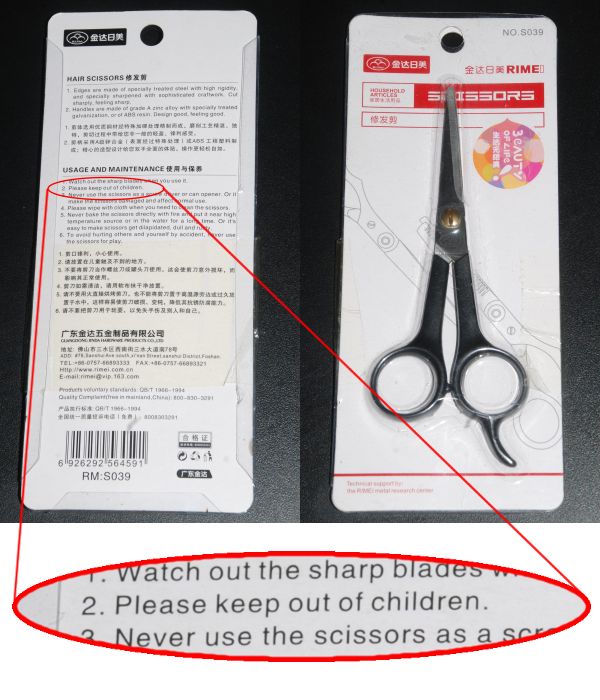
One of the fun aspects of purchasing Chinese stuff on eBay is reading the instruction/warning labels.
Here is the label in its full glory:
Have a laugh, but don't look down on the writer. It's perfectly comprehensible and, if you can get past the poor (but forgivable) word choices, quite a reasonable warning label.
Contrast this to the idiotic warnings and deliberately obfuscated legalese to be found on products made by people whose first (and probably only) language is English.
![]() |
| Does this mean it's OK to stick them into adults? |
Here is the label in its full glory:
Have a laugh, but don't look down on the writer. It's perfectly comprehensible and, if you can get past the poor (but forgivable) word choices, quite a reasonable warning label.
Contrast this to the idiotic warnings and deliberately obfuscated legalese to be found on products made by people whose first (and probably only) language is English.
Sunday, 28 June 2015
Be Kind to Bots
Spare a thought for the automatic checkout machine who lives in a supermarket.
I have heard people swearing and cursing at them (and I've done it myself in the past), sneering at them, calling them stupid and so on, but I've never once heard anyone being polite to them. Anyone who returns the machine's "Thank you" always does so sarcastically.
Think for a moment about what this means.
It's considered acceptable, and even mildly amusing, to heap humiliating insults on a machine, but if you try to do the opposite, people will look at you like you're crazy and maybe say something like "You do know that it can't hear you, don't you?" in a pitying tone.
I find it somewhat worrying that only politeness and not abuse is considered to be irrational, and it's even more concerning when you realise that this is how people would have behaved towards slaves.
Imagine you had a servant, and they didn't understand what you said (through being deaf, or not speaking English, or whatever), would you consider it acceptable to abuse and insult them [assuming you could do so without giving your feelings away by body language]? If not, then why should it be acceptable to swear at a machine - which is literally acting as your servant - just because it can't hear you?
The machine might not be able to hear, but your actions say something about you.
I have heard people swearing and cursing at them (and I've done it myself in the past), sneering at them, calling them stupid and so on, but I've never once heard anyone being polite to them. Anyone who returns the machine's "Thank you" always does so sarcastically.
Think for a moment about what this means.
It's considered acceptable, and even mildly amusing, to heap humiliating insults on a machine, but if you try to do the opposite, people will look at you like you're crazy and maybe say something like "You do know that it can't hear you, don't you?" in a pitying tone.
I find it somewhat worrying that only politeness and not abuse is considered to be irrational, and it's even more concerning when you realise that this is how people would have behaved towards slaves.
Imagine you had a servant, and they didn't understand what you said (through being deaf, or not speaking English, or whatever), would you consider it acceptable to abuse and insult them [assuming you could do so without giving your feelings away by body language]? If not, then why should it be acceptable to swear at a machine - which is literally acting as your servant - just because it can't hear you?
The machine might not be able to hear, but your actions say something about you.
Thursday, 2 April 2015
Soylent Green is Pancakes!
![]() |
| Soylent Green is Pancakes! |
Recently I was given some Soylent to try out. Soylent is a powder that that contains all of the nutrients required to sustain life. You mix it with water and drink it. In principle at least, you could live off the stuff indefinitely. And, yes, the name is an ironic reference to the fictional Soylent Green.
At first sight, it might seem to be a solution looking for a problem. Why would you want to eliminate the pleasure of eating food from your life? Isn't that like using artificial insemination so that you don't have to have sex?
It seems to be advertised on the basis that it's quick and easy to prepare, yet cheaper and healthier than takeaway. The idea is presumably that the archetypal computer geek, assailed with hunger but unwilling to relinquish the joy of debugging the latest Linux kernel to prepare dinner, slugs down a glass of Soylent, rather than ordering in a pizza and coke.
But it has more potential than just a convenience food for the time-poor.
Given that it's light in weight, will keep a long time without refrigeration and can be prepared without any special equipment, it might be useful on expeditions or in remote communities with limited access to fresh food. It would be a good thing to pack away as an emergency ration. It would surely have a place in disaster relief. Also, it might be helpful for those with eating disorders where "normal" food would trigger binging.
It's not going to find a place on everyone's table, but it's potentially a useful product.
![]() |
| An Aussie version of Solylent |
The product I tried was not the original American formula, but an Australian version. The Australian version comes in two varieties; "Chocolate" and "Premium". These differ from each other (and both differ from the American version) in contents and nutritional breakdown. All are formulated for a 2,000 calorie daily diet (obviously you can vary this by eating proportionally more or less). Puzzlingly, the American version has a significant excess proportion of fat and a deficit of fibre. The Aussie versions come much closer to the recommended proportions.
Here is the comparison (the quantities are for a day's worth of servings):
| US Version | AU Version (Chocolate) | AU Version (Premium) | ||||
|---|---|---|---|---|---|---|
| Fat | 96 g | 43% | 52 g | 23% | 67 g | 31% |
| Protein | 84 g | 17% | 121 g | 24% | 101 g | 21% |
| Carbohydrate | 204 g | 40% | 261 g | 53% | 235 g | 48% |
| Fibre | 16 g | 30 g | 48 g | |||
[% refers percentage contribution to total calories]
![]() |
| Mmmm, Soylent! |
Here's what the stuff looks like in person. This is the chocolate flavoured version. The colour isn't totally accurate - it's a fraction more brown than shown - but it's much closer than the example on the aussielent web site, which looks like a photo of pure cocoa powder.
I made half of it up as per directions.
![]() |
| Soylent; like a chocolate milkshake, only |
The flavour was neutral and not unpleasant. After drinking, I felt full; as if I'd had a normal meal. I had thought that it might make me feel starved afterwards, but it seems my body registered the calories and responded appropriately.
The only problem - and this is a significant problem which will need to be addressed if the stuff is going to achieve any sort of public acceptance - is the texture. It's horribly floury; to the extent that it's unpleasant to drink, despite the otherwise acceptable flavour.
It has been suggested that the texture can be improved by letting it stand for a while. Some say it's better at room temperature, and others prefer it chilled. I tried it after standing for a considerable period at room temperature and then in the fridge overnight. I also mixed it thoroughly in a blender. Nothing seemed to make any difference to the texture.
It tasted to me like diluted cake mix or pancake batter.
Pancake batter? Now that's an idea!
![]() |
| If life gives you pancake batter... |
As an experiment, I mixed some of the remaining Soylent with water and made pancakes. Since I only used water, and not the usual eggs and milk, the Soylent pancakes would be nutritionally the same as the original Solyent - with the exception of a little extra fat from the butter used to grease the pan, and possibly minus a small amount of the vitamins due to the cooking process.
The darker colour of the batter meant that the lacy patterns from cooking weren't as noticeable, and also they were a little more brittle (presumably due to the lack of eggs) and had to be turned with care, but otherwise they came out the same as normal pancakes.
Eaten alone, without any toppings, Soylent pancakes are virtually the same as ordinary pancakes but somewhat more flavourful. That is to say, they taste really good. Unlike the original drink, they are something that can be consumed with pleasure.
Needless to say, the remainder of the Soylent was used for pancakes. The picture at the top of this entry is an example. Obviously this goes against the philosophy behind Soylent, but if you're of an experimental frame of mind, I'd recommend giving it a try. As currently formulated, this seems to be the best way to use the stuff.
And here's an idea for some entrepreneur; sell Soylent in the form of pancake-like wafers. You could call it Lembas (which has much more pleasant associations than the loathsome Soylent Green), and cash in on the popularity of the Lord of the Rings
Subscribe to:
Posts (Atom)