Tuesday, 21 March 2017

Dispatches from the War on the Environment

Recently we have been treated to the spectacle of members of the government front bench joyfully fondling a lump of coal, with Deputy Prime Minster Barnaby Joyce displaying an expression of such manic lust that your first instinct is to check that there are no sharp objects within his reach.

But while big attacks on the environment like this grab our attention, a termite-like army of smaller attacks quietly undermine us.

Here are some that have recently come to my attention:

Battery Bullshit


At first glance one would think these were the "World's First Recycled Batteries". (In itself a strange claim since lead-acid batteries have been recycled since approximately forever.)


but read the fine print...


Energizer are presumably claiming a dubious World First in producing alkaline batteries with an incredible "4% of total weight" being made from recycled ingredients. Can you contain your excitement?

Bear in mind here that a large portion of the world's steel production is (and always was) from recycled steel, as it's much cheaper to melt down scrap steel than smelt it from ore. So it's possible the metal casing and end caps of the battery already contribute a substantial amount towards this 4%.

Toilet Paper Scandal Redux


On reading a recent article in Choice Magazine, it turns out that I was too generous in my post "The Great Toilet Paper Scandal"

I had assumed that the paper labelled as "made from 100% recycled paper" did contain at least contain 30% of recycled paper as per the FSC certification.

It turns out that even this not necessarily true; the 30% requirement actually applies to the entire production run (of an unstated but probably fairly large number of products) covered by the FSC certificate. It is actually possible that the paper itself contains no recycled paper, as long as other products in the same line contained proportionally more.

I know many people don't think this is important ("who gives a shit" is one of the extraordinarily witty comments I've heard), but this is a product that everyone uses every day and none of it can be recycled. There are 24M people in Australia, if a toilet roll lasts a person 6 days on average, that's 4M rolls being flushed daily. Which is a lot of trees.

Garbage Bag Garbage


It would be fair to assume that recycled plastic, like recycled paper, is of lower quality than the virgin article. Since a garbage bag is intentionally something that's going to be disposed of in landfill, it's surely something we want to make out of the lowest quality of recycled materials, or out of something that bio-degrades, or preferably both.

So how do the supermarkets respond to this challenge?


Coloured and Scented garbage bags of course!

Looking in one small suburban Coles, there were eight different types of these abominable things being sold.


Of course none were made from recycled materials and all were non-biodegradable. They were however apparently recyclable - which I'm sure is a useful property for something that is intended to be disposed of in landfill.

(Finally) A Reason to Fly QANTAS


Virgin, until now my second least favoured airline, are asking me to "Celebrate our new partnership with EnergyAustralia".


That name sounds familiar...

Apparently they're in the planet killing business:
"Energy Australia, responsible for the Yallourn coal-fired power station in Victoria, is the worst offender at number one with a 20.8 million tonnes of carbon dioxide equivalent gases."
Congratulations, Virgin, you've regained the hotly contested place of my No. 1 least favoured airline by teaming up with Australia's equally hotly contested No.1 polluter.

Even Environmental Organisations Are At It


It is sad that even an organisation like the Australian Koala Foundation is willing to resort to Greenwash tactics. They are selling these signs.

And they write:
"Protect your trees for koalas!  Bright yellow to stand out, made of degradeable polypropylene - lasts for years but will eventually breakdown and return to the earth.  Attach to your tree with a small tack or nail, or tie it on."
"Degradable" is not the same as "biodegradable"! It just means the stuff breaks down into small pieces. Small particles of polypropylene are in fact a considerable environmental problem; they end up in the sea where they're ingested by plankton and enter the food-chain. Recently, cosmetics containing polypropylene micro-beads have been banned for this reason.

OK, these signs are few in number and will ultimately (probably) end up in landfill where they won't do much harm, but, really, an environmental organisation should know better than to be party to this sort of misinformation.

Also, it's not clear why the signs can't be recycled. Polypropylene (recycle code 5) is definitely recyclable.

Friday, 20 January 2017

Turnbull's Victories

Prime minister Malcolm Turnbull has had some big successes since his party formed government.

I will consider here only those successes related to the IT field, since Turnbull is considered by some to be an IT genius who brought the Internet to Australia (he bought shares in the now-defunct Ozemail and sold them a few years later at a massive profit).

To the uninitiated, it might seem that his actual performance has been more like a three-train wreck; that is to say, not only a disaster, but something where you marvel at how it's physically possibly for it to have happened.

[Based on an illustration from here]

But looking at it from the point of view of the Coalition, it has been instead a series of mighty victories.

Victory 1: The NBN


[Based on a stock photo from here]

There is no question that the wrecking of the NBN was deliberate.

Turnbull's FTTN (Fibre-to-the-node) network is inferior to Labor's FTTP (Fibre-to-the-premises) system in every conceivable way. It costs just as much to install, but is orders of magnitude slower, it's not upgradable, it won't last as long, it's much less reliable and it has enormous ongoing operating costs. The technical community - despite an intrinsic right-wing bias - are uniformly against it. Have a look the Whirlpool forum to see what I mean; whenever a Coalition troll ventures in to spruik Turnbull's FTTN, they are immediately shot down with technical arguments by experts in the field.

Not only is this obvious now, but it was obvious right from the start.

Soon after gaining office in 2007, the ALP's original proposal for the NBN was actually something very much like Turnbull's FTTN network. At the time, the Coalition correctly called it out as useless. The term "Fraudband" was actually coined by Nationals Senator Fiona Nash to describe this network.

So the Coalition knew, nearly 10 years ago, that FTTN was a dud.

So how come they ended up in favour of it?

It seems that just before the 2010 election, opposition leader Tony Abbott had a luncheon with his master Rupert Murdoch, whose influence and profits were being threatened by expanding Internet usage.

The very next day Abbott rashly announced that he would destroy the NBN.

I think he was then quickly taken aside and given a stern talking to by his handler Peta Credlin ("Not like that you fool, the NBN is popular; you need to destroy it by stealth"). He therefore entrusted this unpopular task to his main rival, Malcolm Turnbull. I think he expected Turnbull to fail, or at least come out of it looking bad.

Turnbull, however, exerted his lying skills to their fullest. He first proposed a wireless system as an alternative to Labor's NBN, and when that was laughed down, he then went with FTTN. He had a plan fully costed and worked out, he said, and ready to go the moment they won government. It would be a third of the price of Labor's system and would be finished much sooner. Their 2013 pre-election promise was for everyone to be connected by 2016.

The technical community saw through these lies at once (although some took a bit longer), but the Coalition had all of the mainstream media on their side. All of the traditional media stood to lose out as the Internet expanded, so they made sure to stifle any objections to the plan.

Now we can see how things turned out. Nowhere near finished, abysmal speed and reliability, $20B over budget so far; all as predicted. Last time I checked, Australia had dropped to 60th in the world in Internet speed. An appalling thing for a first world country.

In other words, it all happened exactly as planned and is a big victory to the Coalition. Those responsible for getting the Coalition into power  -  the mainstream media, and in particular Rupert Murdoch - have their influence and profits preserved for a little longer. Meanwhile, the NBN has been crippled to the extent of becoming a burden to the taxpayer, so no one will complain when it's given away to Telstra, to further cement their monopoly position.

What is the betting we'll see some Coalition politicians offered well-paid positions on the Telstra board when they lose their seats next election?

Victory 2: The 2016 Census


In 2016 there was a sudden increase in the number of people named Winston Smith in Australia
[won't reveal the source of this one ;)]

The ABS (Australian Bureau of Statistics) gathers statistical data on the nation. Reliable data is critical for running the country. If you are distributing resources, you need to know what resources you have and who needs them. If you are implementing a policy, you need to have some feedback on whether it's achieving its goals.

However, since the Coalition came to power in 2013, they haven't had any use for objective data. The decisions they have made have been based on a mixture of ideology and implementing the requests of their corporate sponsors. The problem with having objective data available is that it might contradict these decisions, and in that case there's the need to go through the tiresome process of suppressing the data, censoring or discrediting anyone who publicises it and so on.

Of course it's theoretically possible that, by chance, objective data might support their decisions, but why risk it? Far better to just invent the data as you need to; it's quicker and cheaper to do and always gives the right answer.

Therefore, in 2014, the Coalition made crippling budget cuts to the ABS. These came on top of a previous set of crippling budget cuts by the previous Labor government (who I am by no means defending as they were probably inspired by the same motives).

Things got so dire that when Brian Pink retired as Chief Statistician in January of 2014, they couldn't find anyone to replace him and the department struggled on without a head for several months. But then things got worse: the Coalition appointed David Kalisch as Chief Statistician. Now I don't know for sure that Kalisch is any more than a useful idiot, but there is some reason to believe he's a coalition stooge.

Firstly, Kalisch isn't even a statistician. He is an economist, which these days means someone whose role is to think up reasons why money should taken from the poor and given to the rich. Therefore it would be fair enough to assume that he at least sides with the Coalition politically.

Of interest is that the fact that his appointment was rushed through, along with a number of other partisan appointments, just before Christmas in 2014 - which is a traditional time of year to hide shenanigans.

In February of 2015, he was already spin-doctoring unemployment figures in the government's favour.

Soon afterwards, he was delivering the line that the 2016 census should be scrapped. Given that the census is critically important to the role of the ABS this would seem a very strange thing to say - although not so strange if he was testing the waters on behalf of the coalition.

There was some backlash about this and he was forced to change his tune. Then some Machiavellian plotter (I would like to know who) came up with a quite ingenious strategy: They would announce that, unlike previous years, the ABS would be retaining people's names for data matching purposes.

On the face of it, this didn't make any sense; why expand the scope of the census immediately after you've claimed there wasn't enough money to even hold it at all. Therefore there was much speculation that the motives were entirely sinister. Hitler used the German census data to track down Jews. More recently, the United States used census data to track down Muslims. With those on the left already nervous (if not terrified) about abuses of power by the Coalition there was therefore considerable outcry about this.

This was all part of the plan.

Either no one would care very much and people would fill out their census forms dutifully, thus giving the Coalition a treasure trove of data to use against its enemies, or there would be mass disobedience, which would render the census useless. Either way they would win.

Then came the online census debacle.

Before this happened, I had an inkling that something wasn't quite right. I had heard some people saying the encryption on the ABS server wasn't up to scratch. It's never a good idea to take rumours like this at face value, so I checked myself and it turned out they were right. Specifically; I ran an SSL security check on the ABS server and found the encryption protocols available did not provide Forward Secrecy. Forward Secrecy is something you particularly want with something like a census and it's not difficult to set up.

At the time, even my own personal Possum TV server provided Forward Secrecy. [And I'm not trying to make myself out to be a security guru here; if you can set up a server, it's really not rocket science to configure the encryption right. Literally all I did was Google something like "best SSL configuration for Apache" and followed the instructions on the first (trustworthy) site I found.]

When it came to the actual night of the census, things went worse than even I had thought possible. I have looked at a submission by the ABS to the senate enquiry on this embarrassing business, and despite spinning everything in the ABS's favour, it was still obvious that they were totally unprepared and flew into a flailing panic when things started to go wrong.

After the event, Turnbull beat his chest talking about how he would bring those responsible to account. Still waiting on that. Maybe he should look in a mirror.

Victory 3: Centrelink "debt" recovery


Centrelink's sensitive and understanding robo-debt-collectors
[source]

Words fail me when it comes to describing what a mess they've made of this; it makes even the census debacle look good by comparison. It's like they sent the intern to a short course on whatever retarded programming language they use there, probably COBOL, and asked him write a data matching program, with no oversight, then rolled it out with no testing and met all complaints with the unanswerable "The computer is always right".

However, to say that this incredible debacle is an unintended consequence of cost-cutting is wrong, and to think that it is hurting the Coalition is also wrong. I believe this is all deliberate and the Coalition is benefiting from it.

The people who are upset about this are people who would never vote for the Coalition anyway.

The Coalition is more interested in winning back voters who have deserted it for lunatic Fascist parties like One Nation. The average One Nation voter most probably considers those on welfare to be scum who should be put against a wall and shot. The idea of welfare recipients being mistreated is music to their ears.

The Coalition want this to hurt people. They need it to be unfair, and be seen to be unfair. The more the progressives scream about how evil and stupid it is, the more the One Nationists like it and the more the Coalition knows they are doing the right thing (at least for a certain value of "right").

The Overall Strategy


There is a common theme to all of these victories. They all involve interfering with, and under-funding, key public services to the extent that they become incapable of performing their roles, ultimately leading to spectacular failures.

Quite apart from the benefits to the Coalition listed above, these victories all have some additional benefits in common:

Firstly, the Coalition gets seen to be prudent economic managers because they are "willing to make the tough decisions" to save money. It's true the NBN disaster is costing enormous amounts of extra money, but since the NBN was originally a Labor initiative this can be blamed on Labor.

Secondly, these sort of things get progressives really riled up, thus taking the focus off other extremely important problems - such as the Coalition's bitter and relentless war against the environment and the crimes against humanity being committed in the refugee death camps.

Thirdly - and I think this is the most important reason - it opens the way for privatisation. Noam Chomsky summed up this strategy in a 2011 speech:
"That's the standard technique of privatisation: defund, make sure things don't work, people get angry, you hand it over to private capital."
I'm not sure what their ultimate aim is; possibly some Libertarian paradise where the only government services remaining are the police and military. In which case, future generations will think Orwell's 1984 was a historical novel, and will marvel at how good people had it back then.

Let's hope the in-fighting between the many crazies in the Coalition (e.g. that dickhead Bernardi who somehow thinks there's a need for yet another reactionary fringe party: The "Australian Majority Party". Off to a good start there, idiot - even the name is a lie.) prevent them from achieving this.

Thursday, 29 December 2016

RoHS Complaint


[For the uninitiated: RoHS stands for "Restriction of Hazardous Substances" and is an initiative to reduce the use of stuff like lead and cadmium in electronic devices. And, yes, there is a typo on the label above which has deliberately been replicated in the title of this post.]

One thing that puzzles me about a lot of technical people - that is to say, people with a trade/technician/engineer background - is that they seem to hold an extreme faith in the ability of science and technology to overcome any and every problem, yet they can at the same time be intensely resistant to technological change when it comes to environmental issues.

A specific example of this is lead-free solder.

Lead is a problematic substance. As a solid metal, it's fairly inert and arguably tolerable for some applications, but under the right (or should I say wrong) conditions it can be converted to soluble salts which are really bad news. It's a cumulative poison and toxic to just about every living thing. Consequently, you don't want to go pumping lead into the environment unnecessarily.

Now these days, there are an extraordinary number of short-lived consumer electronic devices available. Many are specifically designed to last only a short time and virtually none are repairable in any way. Regardless, pretty much all become superseded within a very few years.

The old units need to be disposed of. You're meant to take them to special recycling centres, but they're few and far between in many parts of the world. I'd say that well over half end up in landfill.

To say, as some do, that "no one has ever died from lead pollution caused by consumer electronics" is most probably wrong but in any case is disingenuous. It's a cumulative poison - by the time that there's enough of it floating around in the environment that people start dying, we are already totally screwed.

It therefore makes sense to eliminate lead (and similar toxic materials) from electronic devices where possible. Lead-free solder has been in use for many years now and works successfully in all sorts of increasingly complicated devices.

I use lead-free solder.

A quick guide to soldering: The most important thing with soldering is to have the items you wish to join clean, but a close second is to use the right amount of heat. Too much and you burn flux, melt insulation, lift PCB pads and damage components (in roughly that order). Too little and the solder doesn't wet the metal properly. The usual beginner error is to have things too cold.

Lead-free solder makes this process more difficult because it melts at a significantly higher temperature than lead/tin solder, meaning there's a smaller temperature window to operate in.

However, the difference isn't really that great. If you can solder properly using leaded solder, you'll also be fine with lead-free. To use a car analogy: the level of difficulty in moving from one to the other is not like moving from an automatic transmission to a manual; it's more like parking a sedan when you've previously only had to park a mini. That is to say, the same problems apply and you still use the same technique, but there's less margin for error.

For soldering components onto a PCB the difference is barely noticeable. For soldering difficult items the difference is greater; you will for instance have to go to a higher temperature setting (or get out the propane torch) sooner when soldering thicker wire; but it's still fair to say that anything that gives trouble with lead-free solder will also give trouble with the leaded variety.

Now I have had an electrician, who had never used lead-free solder, rant to me about stuff. His attitude was like that of a radio shock jock who'd just been kicked in the groin by an unemployed Muslim asylum seeker.

He told me of the horror of "tin whiskers" (an effect only seen with some very early tin-only solders) and that lead-free solder was the primary cause of the (non-existent) plague of unreliable electronics that supposedly now besets us.

As proof of his point, he mentioned a computer monitor he had purchased which had failed. He had opened it up and found the cause was a defective electrolytic capacitor.

:Sigh: Anyone who has repaired electrical equipment will be aware that electrolytic capacitors are notoriously one of the least reliable electronic components. They have been consistently so ever since they were first invented - decades before lead-free solder had been heard of - and this is due to the electrolyte they contain, which tends to dry up over time. The current ones don't even use solder internally. Blaming the failure of an electrolytic capacitor on lead-free solder is not merely akin to blaming a road accident on the use of unleaded petrol, but doing so when the vehicles involved were both diesels.

The guy must have known this, yet his visceral loathing of lead-free solder was such that he felt justified in telling a flat-out lie to bolster his position.

So it would seem that in the minds of some, lead/tin solder - a substance unchanged since Roman times - is the be-all and end-all of solder and it is not possible for modern technology to improve on it.

But on the other hand, technology can apparently overcome every other possible problem. Permanent manned base on Mars? Fusion power? Tsiolkovsky tower? No problem! The only thing holding us back is the lack of political will.

Anyway...

What I think is quite revealing is that there is nowhere near this level of hatred directed towards surface mount components. Surface mount components are at best diabolically difficult, and at worst impossible, to solder by hand. To continue with the motor vehicle analogies; if using lead-free solder is like parking a sedan as opposed to a mini, then hand-soldering SMDs - even with your beloved lead/tin solder - is like trying to reverse a three-unit road train into a parking space.

Although I expect this will have precisely zero effect on anyone, I would suggest to anyone in the anti-lead-free solder camp to have a good hard look at yourself: Are you being manipulated into an "environment = bad" mindset by those who have a vested interest in being allowed to pollute? Or is it just that you don't know how to solder?

Monday, 31 October 2016

Blinky the Three-eyed Pumpkin


Halloween 2016 [click for larger image]

This Halloween, the house became a nuclear waste dump, complete with a mutant three-eyed pumpkin. Kids were scanned with a Geiger counter and given the antidote (chocolate) when found to be contaminated.

Circuits by Dronny Darko (Neuroplasticity album) was played as background music.

As I've mentioned before, even if Halloween is being introduced into Australia for all of the wrong reasons, it's still a good opportunity to be creative and have fun. Maybe it says something about me, but it's a celebration than comes much more naturally to me than Christmas or Easter.

And if anyone is interested, I based the design for the fake Geiger counter on this instructables post, and I've posted details of what I built under the comments section.

Tuesday, 4 October 2016

The Emperor's New Doughnut

Yesterday I decided to check out a store that has recently opened at a nearby shopping centre. Doughnut Time it was called. It was a cool hole-in-the-wall with a retro neon sign above and music playing. It was surrounded by a crowd of young adults and was obviously very popular with them.

They were selling doughnuts at six dollars a piece.

I purchased a doughnut with the somewhat witty name of "Ferrero No Share". It looked pretty good. On the doughnut was a thick chocolate topping which I had assumed was something like a ganache, with some crumbled hazelnut and topped with a Ferrero Rocher chocolate.


It tasted horrible. It was amazing how bad it was.

The doughnut itself was a moderately good yeast doughnut, but it was completely ruined by the topping. Rather than the beautiful creamy chocolate it appeared to be, it was instead a tasteless, sickly-sweet glaze which for some unknown reason had an unpleasant gritty texture as well. How they managed this I have no idea. The Ferrero Rocher on top was stale (and they go like chocolate flavoured cardboard when this happens), but still managed to taste good by contrast.

It was less good than a 50¢ Coles doughnut.

The name certainly made sense; you wouldn't want to share it - at least not with anyone you liked.


The packaging of this thing contained hip references to trendy stuff such as Snapchat and so I thought I'd check out the hashtag on Twitter. I had always thought that Twitter had a high proportion of cynical people eager to skewer pretentious nonsense like this and I anticipated pages of witty one-liners lampooning this textbook example of style over substance.

But instead it was full of people glorying in the delicious worderfulness of these decadent treats with not a negative voice to be heard. People were bragging (with photographic evidence) about how they were treating themselves to a six-pack of the nauseating things; which is a quantity I have difficulty in imagining any human being able to ingest in a sitting.

Have the marketers (they are certainly not cooks) running the company employed an army of paid trolls to overwhelm the social media or are people really such sheep?

Seemingly the latter: This business has supposedly expanded from a single store last year to over twenty at the moment. Obviously they're very popular and certainly the local store was. The kids were mobbing the place - something I have never seen at the local bakery which has mud-cake slices that are a thousand times better for half the price.

Still, this is in the electorate that recently reelected Peter Dutton (albeit by a very narrow margin), so the qualities of independent thought and good taste are obviously in short supply.

Friday, 8 July 2016

The Great Toilet Paper Scandal

Consider this: Paper made from fresh wood is higher quality than that made from recycled paper. [My understanding is that the fibres get broken down into shorter lengths during the recycling process, thus making the texture worse, and in addition, contaminants (dyes etc.) get introduced, further reducing the quality of the product.] Recycled paper made from paper that had previously been recycled is presumably going to be lower quality again.

Since there is no possibility of recycling toilet paper after use, it would surely make sense to make it out of 100% recycled paper, thus removing lower quality paper from the recycling stream. Virgin paper - whether made from responsibly sourced wood or not - should be preserved for uses where its higher quality is really needed, and where it can be recycled afterwards.

Surely, in these days where pretty much every product claims to be Green in some way or other, we should be able to find toilet paper made from 100% recycled paper.

Here is some.


But it's got freaking pictures of frogs printed on it!  

Are they deliberately trying to take the piss out of us?

OK, what about this? Woolworths "Eco" brand. It says "100% Recycled Paper". Pretty unambiguous.


But look at the fine print. Mix? What does this mean?


The FSC site tells us:


OK, so it's really a mixture, and what is "Controlled Wood"? The FSC site goes on to say:
"FSC Controlled Wood is NOT FSC Certification. Its purpose is simply to ensure the avoidance of wood in FSC Certified sources that come from the following unacceptable sources:
  • Illegally harvested wood
  • Wood harvested in violation of traditional and civil rights
  • Wood harvested from forests where High Conservation Values are threatened
  • Wood harvested from forests being converted to plantations or non-forest uses
  • Wood from forests in which genetically modified trees are planted
It does not provide the full suite of investigation that is provided for by FSC Certification such as ensuring economic viability of the company or other issues in the Principles & Criteria. It is simply to help companies to drive change up the supply chain and encourage Forest Managers to become FSC Certified while proving market demand for FSC material.

The market for Controlled Wood is limited by the reduced ability to label the final product. In a Mix label product, a maximum of 30% of the product can come from Controlled Wood. Controlled Wood is only for trade between Chain of Custody Certificates where they are mixing it with FSC Certified or FSC Recycled Material. For more information about Controlled Wood in Australia, see this page http://au.fsc.org/controlled-wood.207.htm"
So up to 30% of the wood in this product - which is labelled "100% recycled" - may in fact be sourced from timber that is not even fully FSC certified, let alone recycled.

There is a license code (FSC-C109337) on the certification, so let's look it up. Not much to see: there are no documents lodged and it doesn't even tell us what is in the product. But it does say the original manufacturer is Encore Tissue (Aust) Pty. Ltd. [Note: the Encore site is current off the air for some reason, but can be found on WayBack Machine at https://web.archive.org/web/*/http://www.encoretissue.com.au]

On their main page, Encore claim to be "passionate about saving our environment" and that "Someone has to “speak for the trees” before we have none left". Fine words, but a deeper look is revealing. It tells us:
"Encore Tissue’s SAFE®, ICARE™ and EARTHWISE™ Brands are the only tissue products endorsed by Planet Ark.

...

Planet Ark supports a limited range of 'greener' products. Planet Ark supports these products because they have met with certain environmental standards. They must offer a more environmentally responsible alternative to the commonly used products that are on the market, while still being a good, quality product."
So this is actually one of their "greener" products and not actually endorsed by Planet Ark. Yet again, we scratch the thin layer of Greenwash and a much less palatable truth is revealed underneath.

And it's not just Woolworths doing it, but Coles too.


And interestingly they're using the same license code as well.


What appears to be happening here is that:

a) The FSC are having their arms twisted to provide a pseudo-certification just so that retailers can put an FSC logo on their product without it being fully certified.

b) Encore are also having their arms twisted to provide the cheapest possible product that can have this label applied to it. [Either that or they're lying about their green credentials, but I'm willing to give them the benefit of the doubt.]

c) But even this isn't enough for the major retailers and they have to further misrepresent the stuff as being "100% recycled".

What is scary here is that both Coles and Woolworths are so confident that they can get away with telling full-on lies, that they will do this as a matter of course even for minor, unimportant (to them) product lines. To what depths do you think they will descend when it comes to something that might seriously threaten their profits?

Wednesday, 29 June 2016

The nuclear-war-proof toilet

This piece of futuristic technology has appeared in a local park.


It is not an entrance to the underground bunker of some super-villain, or a teleporter to another dimension, but merely a humble thunderbox.

I think it would be accurate to say that it is over-engineered.

Look again at the photo above; the stainless steel door requires a total of five 8-inch-wide hinges to support its massive weight. Does it contain bullet-proof armour intended to withstand a siege?


Rather than a simple vacant/engaged flag on the door latch, there are three flashing LED indicators which signal the status of the toilet to everyone in the vicinity. At night, they are visible from the opposite side of the park.


The interior, which is the size of a small bedroom, is clad from floor to ceiling with stainless steel.


With the exception of the toilet seat, everything in it is stainless, including even the full-length mirror. It must have cost a fortune; the amount of stainless steel in the place would be enough to outfit three kitchens; with enough left over for a small meth lab.


On entering, an American voice announces that you are to press the button to lock the door and warns you that you may stay only a maximum of ten minutes. I'm not sure what happens after this period; maybe an ejector seat activates.

On pressing the door lock button, elevator music is then played at you.

On leaving, the voice - in a carefully calibrated neutral tone - thanks you for using the facility. I am sure that I've heard that very same voice, and possibly also those same words, in some dystopian science fiction film. "Thank you for visiting Soylent Corporation", or something like that.

[edit July 2017: After some research I think the quote I'm thinking of is "Welcome to Delos" and comes from the 1973 film Westworld, which I haven't actually seen. I came across it as a sample in a long forgotten song, probably by a short-lived 1980s Adelaide band. It is immediately followed by another sample in which a terrified voice exclaims "that's not supposed to happen!" ]

Why?

Why is it necessary to spend money on such a thing?

Everyone is crying poor these days, and the local council doesn't seem to have enough money to police developers who are breaking their regulations left and right. There is no money to put up nest boxes or wildlife bridges to cope with animals displaced by the aforesaid rapacious developers. Clearly the koalas and sugar gliders count for nothing in comparison to the glory of constructing a super-toilet.

I get that it looks cool and it's probably fairly vandal proof (at least until someone calculates the scrap value of all that stainless steel and gets at it with a crow-bar), but is it needed? Is it worth it?

Given that you could probably afford to completely replace a standard toilet a dozen times over for the cost of this thing, I don't see how it would ever pay for itself in terms of resistance to vandalism. I don't see how it provides any special security for the user either; sure you're invulnerable to anything short of heavy artillery when ensconced within this fortified enclosure, but as soon as you leave, the bad guys can grab you, then force you back inside where the massive construction will stifle your screams.

All in all, it's a piece of misapplied technology - the wrong solution to the wrong problem.

Monday, 20 June 2016

QANTAS Baggage Handlers Strike Again!

The QANTAS baggage handlers have got me again, and I have to say they did an impressive job this time.


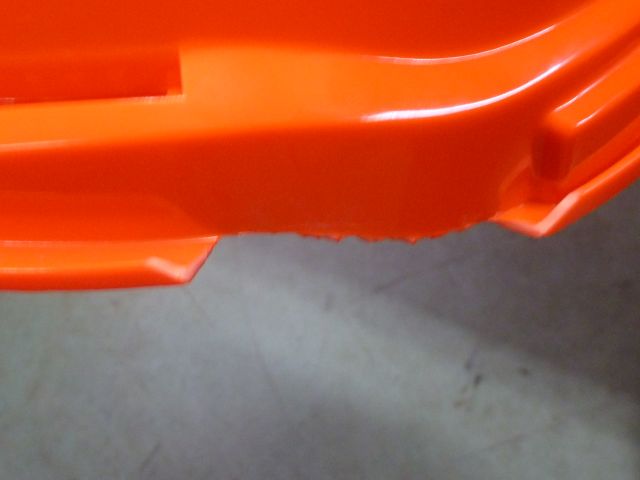
They actually managed to destroy a hard hat - that is to say an item specifically designed to protect against impact - that was packed in my luggage.

The left side was cracked...
and the right side was cracked...
and they took a chunk out of the back as well.

You will notice that this hard hat looks otherwise unused, and this is indeed the case; it was newly purchased because Qantas had managed to break my previous one as well.

In the previous case, the damage was not so great; merely a small crack along one edge. It was just big enough to write the hat off. Obviously they counted this as a poor effort and vowed to do better next time.

I have made a damages claim. I admit this was bit petty, but I was waiting on the phone to complain about being overcharged for extra baggage, and in the hour and a half it took for them to answer I soothed my irritation by occupying myself with this task.

Needless to say the process of making a damages claim is unduly complex and laborious and also you won't be surprised to hear that this happened two weeks ago and they have yet to do anything more than send an automated reply. It seems that they don't exert themselves to reply promptly; their automated reply casually informed me:
We aim to respond to your feedback and make contact within the next 15 working days where possible.
So they might respond to me within three weeks, but don't make any promises; whereas a damages claim will be rejected if it isn't completed within three days.

I have to say that QANTAS pisses me off and I think that if they treat their employees as badly as their customers, it's no wonder they take out their frustration with baggage kicking competitions.